I'm pleased to have mystery writer Donis Casey here--I'm a huge fan of historical mysteries and she's created a brilliant series set in Oklahoma during the early years of the 20th century. I can't thank her enough for agreeing to appear here.
Bringing the Past to Life
The Scottish novelist Peter May once wrote that “the purpose of research is to inform you, the writer. So that when you come to write, you do so from a position of knowledge... [and so] your reader can trust that you know what you’re writing about.” I write a historical mystery series set in the 1910s featuring a forty-ish woman named Alafair Tucker, who lives with her husband, Shaw, and their ten children on a prosperous horse farm outside of Boynton, Oklahoma. Being as I have no children, have never lived on a farm, never cooked on a wood stove, washed in a iron tub, or sewed on a treadle sewing machine, much less butchered a hog, I do tremendous amounts of research so that I’ll know what I’m talking about.
But only a very small percent of the research I do for each book finds its way onto the page. I’m not writing a history book, I’m trying to create a world, and it’s amazing how little it takes to add just that perfect touch of authenticity to your story.
Years ago, I went to see Laurie R. King speak at Poisoned Pen Bookstore. She was promoting her stand alone, Touchstone, which takes place shortly after WWI. After her talk, I raised my little hand and asked her how much research she does into her setting and time period before she begins writing, and she replied that she does very little beforehand. Instead, she starts writing, and as she writes she discovers what she doesn’t know, and then looks it up.
I do something similar. For each book, I keep a notebook and file full of information that I read up on as I need it. Much of my research may not be used, for as a book advances, some of the ideas I started out with fall by the wayside. Even so, when the book is finally done, I will have added quite a bit to the huge amount of arcane knowledge rattling around in my head.
Why, then, do I spend so much time learning everything I can about the times, lives, and mores of my characters when I know I’m not going to write about most of it? Because my own familiarity with the era I’m writing about is going to show without my having to make a big deal of it. The characters are going to move naturally through their world without thinking about it, just like we do in our own world.
Alafair ponders a problem while scraping the ashes from the fire box in her kitchen stove before breakfast. She doesn’t think about the history, configuration, or general use of the cast-iron, wood burning stove in rural Oklahoma in 1915. But I do. It isn’t a bit important to the story that the reader knows any of those things either. All she needs to know, or cares about, is that Alafair ponders a problem while scraping the ashes from the fire box. One single sentence in the book represents an hour of research and quite an education in cast iron cook stoves for me that may or may not ever be used again. Yet, isn’t that a picture? One tiny detail triggers a mental image and puts the reader in a country kitchen early one morning in 1915.
You always have to respect your reader’s intelligence. Avid mystery readers are often more savvy about how mystery plots are routinely constructed than the writer is, so you’ve really got to be imaginative and on your toes to fool them. And fool them in a logical way. Same thing with readers who love historical novels. The writer has to be really careful not to make egregious mistakes about the time period - events, language, clothing, tools, conveyances.
It’s a tightrope. An author wants to create as authentic a world as she can, but the whole point is to engage and involve your reader in your story, not to write a history book (or handbook on police procedural, or treatise on forensic psychology.) A novelist should strive to be just accurate enough not to alert the anachronism police.
I have just begun writing my sixth book in the Alafair Tucker series. In the earliest novels, Alafair was only vaguely interested in the events of the time. To a farm wife in the middlest of the middle of the United States in 1914, the war in Europe seemed as far away as the moon. But now, I’m getting to a time period where the affairs of the mighty are intervening on her world whether she likes it or not.
The upcoming book is set here in Arizona, where I live, rather than in Oklahoma, where Alafair lives. So here are the problems I have to solve before I even begin: 1. Why on earth would Alafair go to Arizona in the first place? 2. Once she gets there, what is going on that she could get herself involved in, how, and why? So in order to start to construct my story, I began with a trip to my nearest university library where I read through every issue on microfilm of the Arizona Republican newspaper for late February and early March of 1916, and thanks to interlibrary loan, I did the same for the Muskogee (Oklahoma) Phoenix.
I discovered that in Oklahoma, the end of 1915 and the beginning of 1916 were some of the rainiest months in years, accompanied by severe flooding. Therefore, there was lots of flu and bronchitis going around - enough that it was mentioned in the newspapers. Handily, in the late 1800s through the mid-1900s, Arizona was known as a place where people with chronic lung problems came to let the dry air cure them. Problem number one, solved!
And problem number two? There was a revolution going on in Mexico at the time, as well as the war in Europe. The Mexican Revolution interested the Germans no end, and there were lots of German “military advisers” in Mexico. Even better, in the first three months of 1916, residents of the entire Southwestern U.S. were hysterical over the possibility of a cross-border invasion from Mexico by the Revolutionary Army of Pancho Villa. In fact - and now that almost 100 years have passed, I can be happy about it - in March 1916, the Villistas did exactly that, increasing the hysteria in Arizona to a fever pitch.
For icing on the cake, during the winter of 1915-1916, a major (silent) motion picture, The Yaqui, was being shot in Tempe, the very town in which I set my novel.
If I can’t make a story out of all that, I should have my authorly epaulets ripped off.
Bio
Donis Casey is the author of five Alafair Tucker Mysteries,The Old Buzzard Had It Coming, Hornswoggled, The Drop Edge of Yonder, The Sky Took Him, and the just released Crying Blood. Her award-winning series, featuring the sleuthing mother of ten children, is set in Oklahoma during the booming 1910s. Donis lives in Tempe, AZ.
Blurb
"Crying Blood is a thoroughly engrossing evocation of life on a self-sufficient 1915 Oklahoma farm. In Alafair Tucker, mother of ten, Donis Casey has created a clear-eyed woman of her time... This is my first meeting with Alafair Tucker and her family. It will not be my last.” -- Margaret Maron
Links
http://www.doniscasey.com/
http://www.typem4murder.blogspot.com/
http://www.fatalfoodies.blogspot.com/
------
Thank you, Donis! I don't know about your other readers, but I (for one) do appreciate the research you do, because I have actually had experience with a wood-burning stove (very messy), washed in an iron tub, and sewed on a treadle sewing machine. Thank goodness those are not regular events in my life, however. LOL Poor Alafair.
Monday, June 06, 2011
Friday, June 03, 2011
Indie Publishing and Marketing
I recently wrote another blog for Voices of The Heart about indie (as in independent) publishing versus legacy (or traditional) publishing. It's a hugely popular subject at the moment. Authors struggling to find an audience and make a living at their craft see a handful of authors like J.A. Konrath and Amanda Hocking not only making a living but becoming rich on independently published books. Everyone wants to match their success, or at least be able to pay their bills. Or, even earn enough to pay for their writing-related expenses.
With each passing day, it seems like more and more established authors are hauling out their backlists or even previously unpublished books, blowing off the dust, and squirting them off to Amazon, Barnes & Nobles, and Smashwords to make a few bucks. Which makes it even harder for less well-known authors to find their audience as their books are literally submerged under a tsunami of books all in the same genre.
Answers are wishy-washy at best. All of us are mystified about what makes a reader buy one book over another. Read Konrath's blog if you don't believe me. He's experiemented with pricing, blurbs, covers, etc, and still can't quite decide what makes one of his books sell more than another. As for marketing, the most successful independent author out there, Amanda Hocking, is the first to admit she has no idea why her books took off and sold so well. She did shockingly little marketing (frankly, almost none).
As for me, after five small press/legacy published books that haven't quite paid for my writing expenses yet (dues to various writing organizations, paper, ink, that sort of thing), I went indie with one of my latest mysteries and am just as mystified as the others when I see that book, priced at a lowly $.99 outselling my five other books, combined. In fact, by the end of the year, it will have earned more money than I got for an advance for my mystery that isn't even out yet (due out in hardcover in 2012). That's if it continues to sell at the current rate. I'm not even assuming it may increase in sales, or adding in the second book I have coming out soon.
So what conclusions can we draw?
There has to be something....
- Price. Price is a huge factor and it has nothing to do with any esoteric "artistic value to the reader". Get over that idea right now, it will only cause you to make terrible decisions. A lot more people are willing to buy a book at $.99 than at $7.00. It's the revenue stream that matters, not the individual unit price. Believe me. I know. To tempt readers, you need at least one book for $.99 as an "entry-book". (Think like drug pushers and you'll do just fine.)
- Cover. You need a great cover. Or at least not an appallingly bad cover. Or a cover that looks like your 7-year-old daughter created it as she twirled around in a pink tutu. It should look professional.
- Blurb. You need a great blurb. No errors. One that tempts and teases the reader. One that grabs and won't let a reader rest until they buy the book and find out what it's all about. Present the core of the conflict and make it pithy.
- Marketing. To a large extent, marketing is a waste of your time. There are only a few things you can really do that make a difference. Here they are: get reviews for your book; participate in blogs that are NOT hard sells of your book--you need to provide something of interest that may be related to your book, but stop just talking about your book (for crying out loud); participate in some of the groups out there but not as a poster of excerpts, but as a real human with interesting ideas, opinions, etc; Twitter--but not about your book all the time.
- You'll notice a theme under marketing: shut up about your book, already. What you're looking for is to build a social network and provide your friends and readers with interesting information. It can be related to your book, but if all you do is squirt excerpts out everywhere and post solely about your book, then people will tune you out. They'll have no reason to listen. As Konrath says: it's all about content. Give them something of value. I've seen a huge change in the success of my marketing strategy--such as it is--when I simply stopped chatting up my books all the time. In fact, I sold more books than ever during the month when I was off the 'net entirely and not doing any marketing whatsoever.
- Note: My first month of sales beat the last year of sales for all of my five previous small-press books combined. Last month tripled that number. This is for ONE book. If my book remains at the same level of sales, by the end of the year I will have already earned what I got as an advance for my most recent legacy-published book. By the time that legacy-published book comes out in 2012, I'll have already earned TWICE that advance; and that is if the sales of my one book remain flat at the current level.
- Sadly, success breeds success. If your book starts generating sales, that will generate more interest. More interest will generate more sales. This happens organically, on its own, and there's pretty much nothing you can do about it. Except... - Write. Your very best tool is writing the next book and publishing it at a reasonable price. No more than $2.99. Every author has reported that when they published a second (or subsequent) book, it created a jump in sales for all previous books. So your very, very BEST MARKETING tool is...the next book.
- Subject Matter. One of the reasons a lot of folks go indie is because they have a book they couldn't sell elsewhere. Here's the really awkward, wince-inducing thing: if an editor mentioned something like --we're not sure who the audience would be and this genre/subject doesn't really sell... then you need to pause. A big reason why otherwise terrific books that have great covers, perfect blurbs, and a low price don't sell is because readers aren't particularly interested in the topic. Sometimes this is simply because the blurb or description of the story is uninteresting (remember to put the characters and their conflict first--readers connect with the characters--not some artistic or thematic concept-in-the-sky). Sometimes, you've really gone "too far out there" with the story, e.g. Praying Mantis - the story of an epileptic cat-man who is destroyed by love...with a woman who eats cats for breakfast. Literally. You know what I mean.
- If you really intend to write for an audience as opposed to yourself, you have to consider your readers. They come first. They have to, because they're going to pay their money to read your cr*p. Don't make them regret it.
I guess we'll see what happens.
Monday, May 30, 2011
Guest Author: Alina Adams
Please help me welcome romantic mystery writer Alina Adams! She is doing some phenomenal stuff with combining various forms of entertainment and has a fantastic new mystery involving figure skating. So I won't waste any more of your time, here is Alina!Confessions of a Writer…
By Alina Adams
As a writer, I have a deep, dark confession to make.
I like television.
A lot.
When I moved to the United States at the age of seven without speaking a word of English, television was there; offering entertainment, friendship, and remedial reading lessons.
I watched it all: sitcoms, soaps, sci-fi, talk shows, game shows, the 3:30 Movie…
No one was too surprised when I ended up working in television.
The fact that I also write books seems to throw some people for a loop, though.
It really shouldn’t. Often, I would read while watching television. (It takes a lot to keep me entertained). And I certainly did my homework with the TV on. (Who doesn’t?)
Professionally, I kept my careers pretty separate. I wrote romance novels for AVON and DELL while also writing and producing soap segments for ABC Daytime and the Daytime Emmy Awards. The closest my two worlds came to overlapping was when I used my experience as a television researcher for ABC, ESPN, NBC and TNT’s figure skating coverage to set the background for my series of Figure Skating Mysteries (Berkley Prime Crime).
While working for Procter & Gamble productions, I wrote tie-in books for their TV properties, “As The World Turns” and “Guiding Light.” I also developed a website for them, http://www.anotherworldtoday.com/ , where I combined vintage clips from their soap opera, “Another World,” with fresh written content.
If I could do it for them, why couldn’t I do it for myself?
Especially now that, with the advent of iPhones and iPads and assorted other, non-Apple products, it’s possible to both read an e-book and watch a video at the same time. (Kind of like when I’d do my homework in front of the TV! See, Mom and Dad, I told you it would be a useful skill…. Someday.)
I was going to build an enhanced e-book. Even if no one was quite sure what precisely that was, yet.
Simon & Schuster gave it a try, debuting the Vook (www.vook.com). They offered mostly non-fiction titles, along with a romance by Jude Deveraux and a thriller by Richard Doetsch. (Other fiction titles they just enhanced with non-fictional elements, like authors talking about their books, historical documents, etc…)
But none of those were precisely what I was looking for.
So, I decided to make up my own genre. Because I’m like that. (An obvious side-effect of too much reading and watching TV simultaneously.)
In cooperation with The Ice Theatre of New York (http://www.icetheatre.org/ ), I took an excerpt from my fifth mystery, “Skate Crime,” and enhanced it with videos that actually (I hope) contribute to the story.
And when I say I did it, I mean my husband, the MIT-educated engineer, did it. I just stood over his shoulder and said, “No, not like that. That’s not it. Nope, not that either,” until he finally read my mind and built what I wanted. (I’m like that, too.)
The result is Skate Crime: Multimedia (http://tinyurl.com/SkateCrime ) not exactly a book, not exactly a movie, but… something.
Is it the wave of the future?
I’ll tell you the truth: I have no idea.
I’ll tell you another truth: Neither does anyone else. (And if they say they do, they’re either lying, or whistling into the wind, hoping to hold onto their jobs until retirement.)
Despite the millions of iPads touted sold, we still haven’t hit a tipping point of people looking for enhanced content in their books.
Will that day ever come?
See my answer above.
But, then again, I’m betting that it will. I intend to enhance all five of my Figure Skating Mysteries, as well as my romance novels.
I’m taking a chance (kind of like my parents did when I was seven years old and they decided to pick up and leave the Soviet Union for America; sight unseen)…. Who’s with me?
A bit about Alina:
Alina Adams has written NYT Best-selling soap-opera tie-ins, figure skating mysteries, Regency and contemporary romances, and non-fiction. She can be reached through her website, http://www.alinaadams.com/ . “Skate Crime: Multimedia” is available through Amazon.com.
----
Thanks, Alina! All I can say is...wow!
I'm really looking forward to the future because I think there are going to be more and more entertainment "products" coming out that combine the best of reading and visual media (e.g. television/movies). This is only the beginning!
Thursday, May 26, 2011
Guest Author: Jacqueline Seewald
Please help me welcome mystery writer Jacqueline Seewald
Multi-award winning author Jacqueline Seewald has taught creative, expository and technical writing at the university level as well as high school English. She also worked as an academic librarian and an educational media specialist. Eleven of her books of fiction have been published. Her short stories as well as poems, essays, reviews and articles have appeared in hundreds of diverse publications and numerous anthologies. Her paranormal romantic mystery novels, THE INFERNO COLLECTION and THE DROWNING POOL, have been widely acclaimed. The third romantic mystery in the Kim Reynolds series, THE TRUTH SLEUTH, is a new release. Her recent historical romance set in the Regency period TEA LEAVES AND TAROT CARDS is available in both hardcover and large print editions. A young adult novel, STACY’S SONG, was also recently published to excellent reviews.
So here's Jacqueline!
I’ve now written three novels in a paranormal romantic mystery series. The new murder mystery is THE TRUTH SLEUTH to be published by Five Star/Gale in hardcover edition June 8th and available for pre-order from Amazon, B&N, Target, Borders, etc.
Each of the three novels feature Kim Reynolds, an academic librarian, accustomed to doing research. As she observes to police detective Mike Gardner, reference work is a lot like police detection, you’re trying to solve puzzles and find information that leads to a solution.
With the first novel of the series, THE INFERNO COLLECTION, I wrote the book and rewrote it many times and did considerable research on the topic of inferno collections, both historical and current. Eventually, I cut away over a third of the novel because I felt it should be a fast-paced thriller. I wanted to provide readers with an exciting experience. I attempted to write a novel that would build in tension.
Several of the men who’ve read the book have observed that it has a feminist message. A number of reviewers also commented on the thoughtful ideas in the book and its depth of meaning. Some readers have liked the fact that the novel is something of a “literary” work as well as in the mystery/thriller genre. Different strokes for different folks. I’m hoping that many people, men and women alike, will choose to read and enjoy these mystery novels.
I’ve been asked many times: what is an inferno collection? Simply put, it’s a collection of “condemned” banned or censored books. When a reader/reviewer of The Inferno Collection asked if inferno collections actually exist, I responded that not only did they exist in the past but still exist in more sophisticated and subtle forms today.
It is a fact that librarians have viewed themselves as gatekeepers. For example, libraries such as Boston Public at one time found it necessary to maintain separate inferno collections of banned books considered inappropriate for general public display and reading. Often these were books deemed salacious such as James Joyce’s Ulysses. Another example is the Robert Winslow Gordon "Inferno" Collection in the Archive of Folk Song, Library of Congress, consisting of material separated out because of bawdy and scatological subject matter. Paul S. Boyer in his article “Boston Book Censorship in the Twenties” observed that Boston’s censorship began with the very first governor of the Plymouth colony, William Bradford, but became notorious in the 1920’s when the phrase “banned in Boston” took on new meaning.
It is not only governments and libraries that have chosen to ban books found objectionable for various reasons. Materials are often deemed unacceptable for political or religious reasons or are considered profane, pornographic or sexually too explicit for youth. Publishers and booksellers make these decisions and determinations as well. However, it is well to keep in mind that good books often stir controversy. They are designed to question and make people think. That is not something to fear or repress but rather to admire and respect. As Voltaire, author of the banned satire Candide, once stated: “I do not agree with what you have to say, but I'll defend to the death your right to say it.”
I hope that many readers will enjoy the three novels in this series: The Inferno Collection, The Drowning Pool and The Truth Sleuth.
Multi-award winning author Jacqueline Seewald has taught creative, expository and technical writing at the university level as well as high school English. She also worked as an academic librarian and an educational media specialist. Eleven of her books of fiction have been published. Her short stories as well as poems, essays, reviews and articles have appeared in hundreds of diverse publications and numerous anthologies. Her paranormal romantic mystery novels, THE INFERNO COLLECTION and THE DROWNING POOL, have been widely acclaimed. The third romantic mystery in the Kim Reynolds series, THE TRUTH SLEUTH, is a new release. Her recent historical romance set in the Regency period TEA LEAVES AND TAROT CARDS is available in both hardcover and large print editions. A young adult novel, STACY’S SONG, was also recently published to excellent reviews.
So here's Jacqueline!
I’ve now written three novels in a paranormal romantic mystery series. The new murder mystery is THE TRUTH SLEUTH to be published by Five Star/Gale in hardcover edition June 8th and available for pre-order from Amazon, B&N, Target, Borders, etc.
Each of the three novels feature Kim Reynolds, an academic librarian, accustomed to doing research. As she observes to police detective Mike Gardner, reference work is a lot like police detection, you’re trying to solve puzzles and find information that leads to a solution.
With the first novel of the series, THE INFERNO COLLECTION, I wrote the book and rewrote it many times and did considerable research on the topic of inferno collections, both historical and current. Eventually, I cut away over a third of the novel because I felt it should be a fast-paced thriller. I wanted to provide readers with an exciting experience. I attempted to write a novel that would build in tension.
Several of the men who’ve read the book have observed that it has a feminist message. A number of reviewers also commented on the thoughtful ideas in the book and its depth of meaning. Some readers have liked the fact that the novel is something of a “literary” work as well as in the mystery/thriller genre. Different strokes for different folks. I’m hoping that many people, men and women alike, will choose to read and enjoy these mystery novels.
I’ve been asked many times: what is an inferno collection? Simply put, it’s a collection of “condemned” banned or censored books. When a reader/reviewer of The Inferno Collection asked if inferno collections actually exist, I responded that not only did they exist in the past but still exist in more sophisticated and subtle forms today.
It is a fact that librarians have viewed themselves as gatekeepers. For example, libraries such as Boston Public at one time found it necessary to maintain separate inferno collections of banned books considered inappropriate for general public display and reading. Often these were books deemed salacious such as James Joyce’s Ulysses. Another example is the Robert Winslow Gordon "Inferno" Collection in the Archive of Folk Song, Library of Congress, consisting of material separated out because of bawdy and scatological subject matter. Paul S. Boyer in his article “Boston Book Censorship in the Twenties” observed that Boston’s censorship began with the very first governor of the Plymouth colony, William Bradford, but became notorious in the 1920’s when the phrase “banned in Boston” took on new meaning.
It is not only governments and libraries that have chosen to ban books found objectionable for various reasons. Materials are often deemed unacceptable for political or religious reasons or are considered profane, pornographic or sexually too explicit for youth. Publishers and booksellers make these decisions and determinations as well. However, it is well to keep in mind that good books often stir controversy. They are designed to question and make people think. That is not something to fear or repress but rather to admire and respect. As Voltaire, author of the banned satire Candide, once stated: “I do not agree with what you have to say, but I'll defend to the death your right to say it.”
I hope that many readers will enjoy the three novels in this series: The Inferno Collection, The Drowning Pool and The Truth Sleuth.
Wednesday, May 25, 2011
Quick review of a Cozy Mystery Perfect For Summer
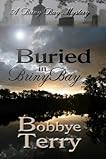
Buried in Briny Bay by Bobbye TerryMy rating: 4 of 5 stars
Buried in Briny Bay by Bobbye Terry may be the perfect beach read this summer. It's a fast, funny mystery with a pair of zany, wisecracking female sleuths named Roxie and Trixie, who can't seem to stay out of trouble.
Another reviewer mentioned a similarity to the old "I Love Lucy" shows and after hearing that, it's hard for me to avoid writing that, too, because it was very apt.
You see, Roxie has been going around town venting her frustration at her nemesis, Georgia Collins, by detailing macabre ways she'd like to see Georgia die. Unfortunately, when Georgia dies by one of those very ways, it starts to look bad for Roxie. It gets even worse when other victims are found, each dispatched with one of Roxie's methods.
Roxie and Trixie soon hire Greg Norris to help them investigate and...well, I don't want to spoil it.
The story moves quickly, so it really is great for relaxing at the beach.
If you like cozy mysteries with a touch of humor, you won't be disappointed!
View all my reviews
Friday, May 20, 2011
Guest Blogger: Stephanie Burkhart
Today, I'd like to welcome Stephanie Burkhart and invite her to talk about the research she did for her historical novel. I'm always fascinated by the hard work that goes into writing a good book, so it was wonderful of Stephanie to "feed" my addiction to research.
Take the Journey – Research
I'd like to thank Amy for having me here today. My latest release is "The Wolf's Torment." Set in 1865 in Romania, Crown Prince Mihai has a secret - he's a witch. Can his love for Theresa give him the courage he needs to save his family from the werewolf that haunts them?
Ambitious, huh? Challenge #1 – setting the novel in Romania, a place I've never been. Challenge #2 – how to blend in the culture and myths of Romania to give it a rich authenticity.
The research wasn't going to be easy – or was it? –wink.
ROMANIA
Honestly, I've never been to Romania, but I have been to Hungary, only 1 nation away. In that regard, I knew the climate and landscape of Hungary. It reminded me of upstate New York. I haven't been to the Black Sea, but I've been to Lake Ontario in the Great Lakes. Thank goodness for "Lonely Planet!" The travel guide confirmed what I suspected and I was able to use my memories of upstate New York and Hungary to bring Mihai's Romania to life. The novel opens during wintertime and goes through to the following autumn. You can see your breath in the winter and feel invigorated as you watch the spring flowers bloom.
CULTURE & MYTHS:
My library/book research was limited. I found a great book on the history of the Black Sea that talked about its rich history since the ancient Greeks and Romanians. In the library, I found several book about Romania in general. Those books gave me general ideas to follow. It was the Internet research that filled out the details.
I used the Internet to search out Romanian names, the language, the food, specific places such as Bran Castle, (for the style and architecture of Romanian castles) Orthodoxy, holidays, supernatural myths and history of the region. Boy, did I learn a lot!
Romanians are the descendants of the ancient Romans who settled the area. Constantinople was to the south and considered the second Rome. When Constantinople broke away from Rome and became Eastern Orthodox, Romania's religion did as well.
Orthodoxy is a beautiful religion and it's marriage ceremony is very involved with the couple crowning each other at the end. For an example think "My Big Fat Greek Wedding."
Romanian names have Latin origins. "Mihai" is Romanian for Michael, pronounced "Ma-high."
Martisor is a Romanian holiday which occurs on 1 March. It's the beginning of spring and its customary for the men in the family to give the women a small token for good luck in the upcoming year. Gifts include flowers, seashells or jewelry.
For a taste of Romania, "The Wolf's Torment" is full of flavor.
REVIEWS FOR THE WOLF'S TORMENT
From The Pen & Muse:
A complete werewolf story through and through, Burkhart does it again with an amazing cast of characters, entertaining dialogue and plot. Lovers of historical paranormal romance will enjoy this read, the first in the Moldavian Moon series.
Link: http://thepenmuse.net/archives/2720
From Reader's Favorites
5 Stars - The Wolf’s Torment has it all, witches, werewolves, a vampire, a princess and a prince. This is paranormal romance at its finest.
Link: http://readersfavorite.com/cat-71.htm?review=4120
Enjoy this Excerpt:
There was a knock on the door and the ladies entered, Sonia followed by Theresa and then Beatrice. Everyone exchanged polite hugs, but Sonia kept her hugs very light. Her cheeks were pale.
"Sonia, how are you feeling?" Viktor put his drink down, but wasn't quite sure what to do with his hands, first jamming them into his pockets before restlessly pulling them out and clasping them behind his back.
"I'm just tired, that's all." She sat down on the sofa. A tray of tea and small scones were laid out for the ladies. Beatrice sat down next to Sonia and steeped a chamomile tea bag. Mihai detected the scent quicker now with Beatrice's instruction.
"This tea will help you," said Beatrice. "It's chamomile."
Sonia reached for the cup exchanging a knowing look with Beatrice.
"Thank you." Theresa sat down on the other side of Sonia and gently rubbed her back. Mihai's father clapped his hands. "Well, I can't tell you enough how pleased I am that you and Viktor are expecting a child, but I want you to take care of yourself. You must stay well for the child."
"I'll go to bed early tonight," Sonia replied.
"Sonia's in fine hands, Your Majesty. Dr. Stanza is quite capable and Mrs. Nocesti from the hospital has agreed to be her mid-wife," said Viktor. His voice broke with concern, but he didn't go to Sonia.
Mihai knew Sonia grew anxious when Viktor got too close to her, so Viktor had to do it in other ways and his eyes were no help. As time went on he became used to the changes in the pitch and tremble of his friend's words.
His father drew in a deep breath and he placed a fist over his heart to help steady his breathing. Then he looked up. "I want to wish all the women here a Martisor filled with good luck throughout the year. Spring will be upon us shortly. The Earth will soon be reborn. May you all--" He began coughing violently. He leaned over his desk, bracing his hands on the edge of it for support.
Mihai ran to him and held his shoulders. Viktor grabbed a handkerchief and placed it over the king's mouth, but not before several drops of blood dripped onto the desk. When he finally stopped coughing, Mihai looked at Viktor.
"Get Dr. Stanza," he said in a low voice.
Viktor quickly departed. Mihai helped his father to a nearby chair and the king sat down. He closed his eyes and took deep, labored breaths.
Theresa clutched Sonia's hand, offering support. Beatrice withdrew several small vials from the hidden pockets in her dress. She sniffed two before she found the one she wanted.
"What are you doing?" asked Theresa.
"The doctor, no doubt, will give him laudanum which will only dull his senses and take away the pain. I'm going to give him a little blood root."
"Blood root?" Sonia pursed her lips and a thoughtful look crossed her face. "Blood root is good for the lungs, right?"
"Yes, it is," said Theresa, soothingly. "It will help him. Trust me. It's only called blood root because the root is as red as blood."
Beatrice poured the powdered root into the king's glass, and gently shook it before giving it to Mihai. He put the glass to his father's lips and held it steady between the coughs. Several gulps of liquid made it down his throat. After another minute, his father stopped coughing and rested his head against the side of the chair.
Beatrice put her hand against the king's cheek. "He'll be fine now." Mihai nodded. "I don't feel like talking, Son. Hand out the flowers." His father's voice was weak and raspy.
Viktor walked in with Dr. Stanza. Beatrice looked away and let the doctor examine the king.
"Does it hurt?" asked Dr. Stanza.
"I ache."
Dr. Stanza withdrew a small flask. "Take a small sip. It's laudanum."
His father did so. Mihai clenched his hands into fists. Thank God the ailment hadn't taken his father's wits, but it was robbing him of his mobility, and it wasn't good that he was coughing up blood. It would only get worse.
Beatrice stepped up beside Mihai. "Relax," she whispered.
"Your father needs to rest. I'll take him to his room," said Dr. Stanza. He helped the king to his feet and supported him as they slowly walked out.
Mihai unclenched his fists. "We should continue as my father wanted and pass out the flowers."
"You don't think we should wait?" asked Sonia. "It wouldn't be a bad omen, would it?"
Visit the Book Trailer on You Tube and give it a 'like' at: http://www.youtube.com/watch?v=FzHE2spBeeU
The Wolf's Torment is available as an ebook only on Kindle, Nook, Kobo, and Sony Ereader. Formats include: PDF, html, and epub which can be found on the Publisher's Website at: http://stores.desertbreezepublishing.com/-strse-163/Stephanie-Burkhart-Moldavian-Moon/Detail.bok
About the Author: Stephanie Burkhart is a 911 dispatcher for LAPD. She also served as an MP in the US Army. Multi-published, she has a children's book, "The Giving Meadow" with 4RV Publishing. She's an avid reader , loves coffee in the morning, and her favorite movie "werewolf" is David Thewlis, Lupin from Harry Potter.
You can find me at:
Website: http://www.stephanieburkhart.com/
Blog: http://sgcardin.blogspot.com/
Facebook: http://www.facebook.com/pages/Stephanie-Burkhart-Author/149938795021166
--------
Thanks, Stephanie! I learned something about Romania I didn't know (though I probably should have) so I'm glad you agreed to blog!
Have a great weekend!
Take the Journey – Research
I'd like to thank Amy for having me here today. My latest release is "The Wolf's Torment." Set in 1865 in Romania, Crown Prince Mihai has a secret - he's a witch. Can his love for Theresa give him the courage he needs to save his family from the werewolf that haunts them?
Ambitious, huh? Challenge #1 – setting the novel in Romania, a place I've never been. Challenge #2 – how to blend in the culture and myths of Romania to give it a rich authenticity.
The research wasn't going to be easy – or was it? –wink.
ROMANIA
Honestly, I've never been to Romania, but I have been to Hungary, only 1 nation away. In that regard, I knew the climate and landscape of Hungary. It reminded me of upstate New York. I haven't been to the Black Sea, but I've been to Lake Ontario in the Great Lakes. Thank goodness for "Lonely Planet!" The travel guide confirmed what I suspected and I was able to use my memories of upstate New York and Hungary to bring Mihai's Romania to life. The novel opens during wintertime and goes through to the following autumn. You can see your breath in the winter and feel invigorated as you watch the spring flowers bloom.
CULTURE & MYTHS:
My library/book research was limited. I found a great book on the history of the Black Sea that talked about its rich history since the ancient Greeks and Romanians. In the library, I found several book about Romania in general. Those books gave me general ideas to follow. It was the Internet research that filled out the details.
I used the Internet to search out Romanian names, the language, the food, specific places such as Bran Castle, (for the style and architecture of Romanian castles) Orthodoxy, holidays, supernatural myths and history of the region. Boy, did I learn a lot!
Romanians are the descendants of the ancient Romans who settled the area. Constantinople was to the south and considered the second Rome. When Constantinople broke away from Rome and became Eastern Orthodox, Romania's religion did as well.
Orthodoxy is a beautiful religion and it's marriage ceremony is very involved with the couple crowning each other at the end. For an example think "My Big Fat Greek Wedding."
Romanian names have Latin origins. "Mihai" is Romanian for Michael, pronounced "Ma-high."
Martisor is a Romanian holiday which occurs on 1 March. It's the beginning of spring and its customary for the men in the family to give the women a small token for good luck in the upcoming year. Gifts include flowers, seashells or jewelry.
For a taste of Romania, "The Wolf's Torment" is full of flavor.
REVIEWS FOR THE WOLF'S TORMENT
From The Pen & Muse:
A complete werewolf story through and through, Burkhart does it again with an amazing cast of characters, entertaining dialogue and plot. Lovers of historical paranormal romance will enjoy this read, the first in the Moldavian Moon series.
Link: http://thepenmuse.net/archives/2720
From Reader's Favorites
5 Stars - The Wolf’s Torment has it all, witches, werewolves, a vampire, a princess and a prince. This is paranormal romance at its finest.
Link: http://readersfavorite.com/cat-71.htm?review=4120
Enjoy this Excerpt:
There was a knock on the door and the ladies entered, Sonia followed by Theresa and then Beatrice. Everyone exchanged polite hugs, but Sonia kept her hugs very light. Her cheeks were pale.
"Sonia, how are you feeling?" Viktor put his drink down, but wasn't quite sure what to do with his hands, first jamming them into his pockets before restlessly pulling them out and clasping them behind his back.
"I'm just tired, that's all." She sat down on the sofa. A tray of tea and small scones were laid out for the ladies. Beatrice sat down next to Sonia and steeped a chamomile tea bag. Mihai detected the scent quicker now with Beatrice's instruction.
"This tea will help you," said Beatrice. "It's chamomile."
Sonia reached for the cup exchanging a knowing look with Beatrice.
"Thank you." Theresa sat down on the other side of Sonia and gently rubbed her back. Mihai's father clapped his hands. "Well, I can't tell you enough how pleased I am that you and Viktor are expecting a child, but I want you to take care of yourself. You must stay well for the child."
"I'll go to bed early tonight," Sonia replied.
"Sonia's in fine hands, Your Majesty. Dr. Stanza is quite capable and Mrs. Nocesti from the hospital has agreed to be her mid-wife," said Viktor. His voice broke with concern, but he didn't go to Sonia.
Mihai knew Sonia grew anxious when Viktor got too close to her, so Viktor had to do it in other ways and his eyes were no help. As time went on he became used to the changes in the pitch and tremble of his friend's words.
His father drew in a deep breath and he placed a fist over his heart to help steady his breathing. Then he looked up. "I want to wish all the women here a Martisor filled with good luck throughout the year. Spring will be upon us shortly. The Earth will soon be reborn. May you all--" He began coughing violently. He leaned over his desk, bracing his hands on the edge of it for support.
Mihai ran to him and held his shoulders. Viktor grabbed a handkerchief and placed it over the king's mouth, but not before several drops of blood dripped onto the desk. When he finally stopped coughing, Mihai looked at Viktor.
"Get Dr. Stanza," he said in a low voice.
Viktor quickly departed. Mihai helped his father to a nearby chair and the king sat down. He closed his eyes and took deep, labored breaths.
Theresa clutched Sonia's hand, offering support. Beatrice withdrew several small vials from the hidden pockets in her dress. She sniffed two before she found the one she wanted.
"What are you doing?" asked Theresa.
"The doctor, no doubt, will give him laudanum which will only dull his senses and take away the pain. I'm going to give him a little blood root."
"Blood root?" Sonia pursed her lips and a thoughtful look crossed her face. "Blood root is good for the lungs, right?"
"Yes, it is," said Theresa, soothingly. "It will help him. Trust me. It's only called blood root because the root is as red as blood."
Beatrice poured the powdered root into the king's glass, and gently shook it before giving it to Mihai. He put the glass to his father's lips and held it steady between the coughs. Several gulps of liquid made it down his throat. After another minute, his father stopped coughing and rested his head against the side of the chair.
Beatrice put her hand against the king's cheek. "He'll be fine now." Mihai nodded. "I don't feel like talking, Son. Hand out the flowers." His father's voice was weak and raspy.
Viktor walked in with Dr. Stanza. Beatrice looked away and let the doctor examine the king.
"Does it hurt?" asked Dr. Stanza.
"I ache."
Dr. Stanza withdrew a small flask. "Take a small sip. It's laudanum."
His father did so. Mihai clenched his hands into fists. Thank God the ailment hadn't taken his father's wits, but it was robbing him of his mobility, and it wasn't good that he was coughing up blood. It would only get worse.
Beatrice stepped up beside Mihai. "Relax," she whispered.
"Your father needs to rest. I'll take him to his room," said Dr. Stanza. He helped the king to his feet and supported him as they slowly walked out.
Mihai unclenched his fists. "We should continue as my father wanted and pass out the flowers."
"You don't think we should wait?" asked Sonia. "It wouldn't be a bad omen, would it?"
Visit the Book Trailer on You Tube and give it a 'like' at: http://www.youtube.com/watch?v=FzHE2spBeeU
The Wolf's Torment is available as an ebook only on Kindle, Nook, Kobo, and Sony Ereader. Formats include: PDF, html, and epub which can be found on the Publisher's Website at: http://stores.desertbreezepublishing.com/-strse-163/Stephanie-Burkhart-Moldavian-Moon/Detail.bok
About the Author: Stephanie Burkhart is a 911 dispatcher for LAPD. She also served as an MP in the US Army. Multi-published, she has a children's book, "The Giving Meadow" with 4RV Publishing. She's an avid reader , loves coffee in the morning, and her favorite movie "werewolf" is David Thewlis, Lupin from Harry Potter.
You can find me at:
Website: http://www.stephanieburkhart.com/
Blog: http://sgcardin.blogspot.com/
Facebook: http://www.facebook.com/pages/Stephanie-Burkhart-Author/149938795021166
--------
Thanks, Stephanie! I learned something about Romania I didn't know (though I probably should have) so I'm glad you agreed to blog!
Have a great weekend!
Tuesday, May 17, 2011
Afterwards: Malice Domestic 2011
Better Late Than Never
Good intentions and all that--I attended this year's Malice Domestic in Silver Spring, MD, and fully intended to write about it immediately thereafter. Sorry. Life has a way of happening.
Anyway, I'm here to tell you it was one of the best conferences I've been to! I was so happen to meet folks who love mysteries, both readers and writers! And of course, I was thrilled to get a huge bag of free books. Free is always good, and one of the books was my all-time favorite Agatha Christie, And Then There Were None. Excellent.
Several of the sessions included another of my favorite authors, Sue Grafton (pictured here but partially obscured by the microphone). She was part of a panel along with Laura DiSilverio, Jess Lourey, and Cathi Stoler. The panel, "Gumshoes with Gams: Female PIs on the Job," discussed the rise and development of female private investigators and it was great to hear all the different perspectives on this topic. I really enjoyed it.
I also got to attend "Things We Wish We Hadn't Written: Authors with Belated Second Thoughts" including authors: Dorothy Cannell, Margaret Maron, Nancy Pickard, Hank Phillippi Ryan and Elaine Viets. I read book by all of these authors and enjoyed them tremendously. It was a thrill to see them in person and hear them talk about their books. It's too bad, though, that they are such good writers that they really didn't have many bloopers to talk about. Really, I think I could have done a much better job as I seem to consistently say things that I really shouldn't. :)
I was also asked to be on a panel, "World Building: Making the Past Come Alive" (I'm the person in the green at the far right). The authors included Andrea Penrose, Elena Santangelo, and Elizabeth Zelvin. Our moderator, Sally Fellows, really did her homework and asked us exceptionally good questions. Andrea and I both write mysteries set in the early years of the 19th century (the Regency period) and had both written stories where a woman dresses as a man. It was fascinating to hear that both of us had chosen to do that because of the limitations Society placed on women of the period. In addition, both of us wrote stories sparked by actual women who chose to live as men in order to have the kind of independent life and employment they desired. Andrea's story is far more serious than mine (my Archer stories tend to have a strong, humerous element) but we both wrote our stories for very similar reasons. I'm glad our moderator asked Andrea to speak first as she was so eloquent in explaining that the Regency period saw the start of science and really, Society, as we know it today, so it's hard to resist setting a story in such a fascinating time.
In addition to attending sessions, I was able to meet up with an old friend, Sandra Parshall. Sandra and I used to work on the Fairfax County Audubon Society newsletter eons ago, before I got married and moved south. Oddly enough, we both started writing mysteries and are now, both published! I was so happy to see her again--she hasn't changed a bit in fifteen years. She was a terrific newsletter editor and makes an even better mystery writer!
I also got a chance to catch up with my sister, and we visited Mount Vernan as well as some local Virginia wineries. At Mount Vernan, I bought a small boxwood, since it's pungent fragrance brings back so many wonderful memories of summer trips to Williamsburg and Mount Vernan in the days when those places had just opened to the public. In fact, when we first visited Williamsburg, it was still being excavated and I remember buying their wonderful gingerbread cookies and wandering around the newly exposed foundations of what would eventually be the various historic buildings.
Sadly, I forgot my boxwood at my sister's house, but she has room in her garden for it and there's always next year! I can't wait to attend my second Malice Domestic and see what new authors are participating!
The trip turned out even better than I hoped.
Good intentions and all that--I attended this year's Malice Domestic in Silver Spring, MD, and fully intended to write about it immediately thereafter. Sorry. Life has a way of happening.
Anyway, I'm here to tell you it was one of the best conferences I've been to! I was so happen to meet folks who love mysteries, both readers and writers! And of course, I was thrilled to get a huge bag of free books. Free is always good, and one of the books was my all-time favorite Agatha Christie, And Then There Were None. Excellent.
Several of the sessions included another of my favorite authors, Sue Grafton (pictured here but partially obscured by the microphone). She was part of a panel along with Laura DiSilverio, Jess Lourey, and Cathi Stoler. The panel, "Gumshoes with Gams: Female PIs on the Job," discussed the rise and development of female private investigators and it was great to hear all the different perspectives on this topic. I really enjoyed it.
I also got to attend "Things We Wish We Hadn't Written: Authors with Belated Second Thoughts" including authors: Dorothy Cannell, Margaret Maron, Nancy Pickard, Hank Phillippi Ryan and Elaine Viets. I read book by all of these authors and enjoyed them tremendously. It was a thrill to see them in person and hear them talk about their books. It's too bad, though, that they are such good writers that they really didn't have many bloopers to talk about. Really, I think I could have done a much better job as I seem to consistently say things that I really shouldn't. :)
I was also asked to be on a panel, "World Building: Making the Past Come Alive" (I'm the person in the green at the far right). The authors included Andrea Penrose, Elena Santangelo, and Elizabeth Zelvin. Our moderator, Sally Fellows, really did her homework and asked us exceptionally good questions. Andrea and I both write mysteries set in the early years of the 19th century (the Regency period) and had both written stories where a woman dresses as a man. It was fascinating to hear that both of us had chosen to do that because of the limitations Society placed on women of the period. In addition, both of us wrote stories sparked by actual women who chose to live as men in order to have the kind of independent life and employment they desired. Andrea's story is far more serious than mine (my Archer stories tend to have a strong, humerous element) but we both wrote our stories for very similar reasons. I'm glad our moderator asked Andrea to speak first as she was so eloquent in explaining that the Regency period saw the start of science and really, Society, as we know it today, so it's hard to resist setting a story in such a fascinating time.
In addition to attending sessions, I was able to meet up with an old friend, Sandra Parshall. Sandra and I used to work on the Fairfax County Audubon Society newsletter eons ago, before I got married and moved south. Oddly enough, we both started writing mysteries and are now, both published! I was so happy to see her again--she hasn't changed a bit in fifteen years. She was a terrific newsletter editor and makes an even better mystery writer!
I also got a chance to catch up with my sister, and we visited Mount Vernan as well as some local Virginia wineries. At Mount Vernan, I bought a small boxwood, since it's pungent fragrance brings back so many wonderful memories of summer trips to Williamsburg and Mount Vernan in the days when those places had just opened to the public. In fact, when we first visited Williamsburg, it was still being excavated and I remember buying their wonderful gingerbread cookies and wandering around the newly exposed foundations of what would eventually be the various historic buildings.
Sadly, I forgot my boxwood at my sister's house, but she has room in her garden for it and there's always next year! I can't wait to attend my second Malice Domestic and see what new authors are participating!
The trip turned out even better than I hoped.
Labels:
Malice Domestic,
Mount Vernan,
Sue Grafton,
Virginia,
Williamsburg
Monday, May 16, 2011
Guest Blog: Debra Purdy Kong
I'm a fan of Debra Purdy Kong, so I was thrilled when she agreed to join me and blog about the research she did for her mysteries. Many readers don't realize how much background work authors do to write even the simplest novel. I blame this on authors like Debra. Her books appear effortless, which is the hallmark of a good writer who did a great deal of research.
So here's Debra!
To say that I’m not a prolific writer would be an understatement. My first Casey Holland novel, The Opposite of Dark, took twelve drafts and about that many years to write. Mind you, I was working, raising a family and writing two other novels as well as short stories, articles, and personal essays.
The idea for The Opposite of Dark actually came twenty-five years ago, while I was working a temporary secretarial job for a public bus company here in British Columbia. I remember typing away when a young woman walked in wearing a black leather jacket and mini-skirt, and high heels. In the mid-eighties this definitely wasn’t an acceptable dress code, but I quickly learned that she was working as an undercover security officer for the bus company.
As years passed, I never forgot that woman or her work, so when I was ready to create a new mystery series, I decided to put my protagonist in security. After the seventh or eighth draft, I decided to learn more about the security business to add authenticity to my story. So, at age 53, I answered an ad in the paper for security officers from a company that paid for training.
With some trepidation, I called them up and asked if they could use someone my age. The answer was yes. Apparently, my maturity and work experience was an asset. It proved to be true, as I was assigned to a university campus where young women and female staff often felt more comfortable with women officers, particularly if we had to patrol locker rooms or dorms for a specific reason. I also worked in the communications office, dispatching security officers to different incidents and coordinating with the paramedics and firefighters during emergencies.
After landing a contract with my publisher, I left security work to write full time, but I have to say that I kind of miss security. I learned a lot, and although some might think I’d taken a tough approach to research, the paychecks certainly came in handy. The basic security training I took, including conflict prevention and resolution, is the same that Casey would have taken. Casey, however, is much more of an in-your-face, rule-breaker than I was, but she’s also a lot more interesting.
Since I intended The Opposite of Dark to be the first in a series, I wanted readers to learn about Casey’s family background, as it plays a huge role in the decisions she makes in future professional and personal relationships. In this book, Casey is informed by the police that her father has been murdered in his West Vancouver home. The problem is that she buried her dad three years earlier in an open-casket ceremony in front of a lot of witnesses. Once more, her dad never owned a home in West Vancouver, but he’d always dreamed of one. And so begins Casey’s adventures.
You can visit Debra on the web at: http://www.debrapurdykong.com/index.html
More info about The Opposite of Dark can be found from the publisher at http://bit.ly/i983XE
From amazon.com at www.tinyurl.com/2frw58u or
From chapters/indo and on Kobo at http://bit.ly/gtFSFw
So here's Debra!
Researching the Hard Way
To say that I’m not a prolific writer would be an understatement. My first Casey Holland novel, The Opposite of Dark, took twelve drafts and about that many years to write. Mind you, I was working, raising a family and writing two other novels as well as short stories, articles, and personal essays.
The idea for The Opposite of Dark actually came twenty-five years ago, while I was working a temporary secretarial job for a public bus company here in British Columbia. I remember typing away when a young woman walked in wearing a black leather jacket and mini-skirt, and high heels. In the mid-eighties this definitely wasn’t an acceptable dress code, but I quickly learned that she was working as an undercover security officer for the bus company.
As years passed, I never forgot that woman or her work, so when I was ready to create a new mystery series, I decided to put my protagonist in security. After the seventh or eighth draft, I decided to learn more about the security business to add authenticity to my story. So, at age 53, I answered an ad in the paper for security officers from a company that paid for training.
With some trepidation, I called them up and asked if they could use someone my age. The answer was yes. Apparently, my maturity and work experience was an asset. It proved to be true, as I was assigned to a university campus where young women and female staff often felt more comfortable with women officers, particularly if we had to patrol locker rooms or dorms for a specific reason. I also worked in the communications office, dispatching security officers to different incidents and coordinating with the paramedics and firefighters during emergencies.
After landing a contract with my publisher, I left security work to write full time, but I have to say that I kind of miss security. I learned a lot, and although some might think I’d taken a tough approach to research, the paychecks certainly came in handy. The basic security training I took, including conflict prevention and resolution, is the same that Casey would have taken. Casey, however, is much more of an in-your-face, rule-breaker than I was, but she’s also a lot more interesting.
Since I intended The Opposite of Dark to be the first in a series, I wanted readers to learn about Casey’s family background, as it plays a huge role in the decisions she makes in future professional and personal relationships. In this book, Casey is informed by the police that her father has been murdered in his West Vancouver home. The problem is that she buried her dad three years earlier in an open-casket ceremony in front of a lot of witnesses. Once more, her dad never owned a home in West Vancouver, but he’d always dreamed of one. And so begins Casey’s adventures.
You can visit Debra on the web at: http://www.debrapurdykong.com/index.html
More info about The Opposite of Dark can be found from the publisher at http://bit.ly/i983XE
From amazon.com at www.tinyurl.com/2frw58u or
From chapters/indo and on Kobo at http://bit.ly/gtFSFw
Tuesday, May 10, 2011
Guest Writer: Mary Reed on Misleading Readers
I love to get the inside scoop on how other writers tackle their research and writing tasks--there's a lot more work to writing fiction than you might imagine. So I'm very happy to have Mary Reed as a guest, to talk about how to mislead readers. :) As you might imagine, this is a skill that all mystery writers must cultivate.
MISLEADING READERS
It's been my experience that as soon as someone hears my accent they haul out the kettle and teapot and ask if I take milk and sugar.
This sort of kind gesture to a visitor leads me to thoughts on how to mislead readers by utilising their expectations of a particular type of character in an underhanded way.
The British ex-Indian Army colonel often appears in classic mysteries.
Readers tend to expect him to be a red-faced choleric individual who talks of pig-sticking, regimental messes, and hill stations. His conversation will be punctuated by words such as punkah wallah and tiffin and if married he will refer to his wife as his memsahib. He will doubtless vote Conservative and when serving on the magistrate's bench will fine poachers heavily.
But what if our colonel is spending his retirement working on a volume of philosophical reflections, heartily dislikes Indian cuisine, never wears his medals or attends regimental reunions, prefers his furniture to be in the style of the Arts and Crafts Movement, and thinks women should have the vote?
Quite a different character emerges! Certainly an unusual specimen of his class, easily misunderstood by those -- including the detective -- who would tend to assume that a man of his social position and history would possess certain traits.
But they would be wrong, especially if he is the leading culprit.
To avoid spoilers by revealing those responsible for crimes, as a demonstration of use of misdirection in character expectation consider Agatha Christie's Miss Marple.
Miss Jane Marple appears to be the model for everyone's favourite elderly aunt. She's twittery and fluffy, fond of knitting and gardening, at times somewhat vague. But under that cosy exterior she has an incisive mind and excellent deductive ability, often based upon her superb grasp of the worst aspects of human behaviour from observation over the years of incidents involving her fellow villagers in St Mary Mead.
Christie's Belgian detective Hercule Hercule Poroit in fact to some extent knowingly takes advantage of misleading expectations. To outward appearances he is a fastidious dandy with a comical mode of speech, zealous devotion to an outlandish moustache, and at times, alas, a boastful nature. Those who see only the outward man often regard him as an merely a vain, idiot foreigner and react accordingly. Poirot sometimes misleads by playing up to these expectations -- to the extent of bending the truth at times -- to obtain the information he needs to complete his deductions.
As another example closer to home, the investigations of our protagonist John, Lord Chamberlain to Emperor Justinian, take place in sixth century Constantinople and its imperial court.
John is a eunuch, a condition that is historically correct for one holding his high office.
Whatever readers initially assume a eunuch to be, we feel it's unlikely they will have visualised a lean, inscrutable former mercenary handy with the blade if need be, an austere man with no taste for luxury or rich foods despite living on the grounds of the Great Palace. There is much more to his character, of course, but his condition is what readers tend to react to when first encountering him. And for the record, on those occasions when it must be mentioned we treat it in a matter of fact way, just as John himself does.
Returning to my introduction to this blog, I should add that I rarely drink tea although as a guest I am happy to imbibe it when it's made specially for me since I appreciate the kind gesture.
But at home it's always black coffee with no sugar.
Mary Reed
Our webpage: http://home.earthlink.net/~maywrite/
Co-author Eric Mayer's blog: http://journalscape.com/ericmayer
Thank you, Mary!
MISLEADING READERS
It's been my experience that as soon as someone hears my accent they haul out the kettle and teapot and ask if I take milk and sugar.
This sort of kind gesture to a visitor leads me to thoughts on how to mislead readers by utilising their expectations of a particular type of character in an underhanded way.
The British ex-Indian Army colonel often appears in classic mysteries.
Readers tend to expect him to be a red-faced choleric individual who talks of pig-sticking, regimental messes, and hill stations. His conversation will be punctuated by words such as punkah wallah and tiffin and if married he will refer to his wife as his memsahib. He will doubtless vote Conservative and when serving on the magistrate's bench will fine poachers heavily.
But what if our colonel is spending his retirement working on a volume of philosophical reflections, heartily dislikes Indian cuisine, never wears his medals or attends regimental reunions, prefers his furniture to be in the style of the Arts and Crafts Movement, and thinks women should have the vote?
Quite a different character emerges! Certainly an unusual specimen of his class, easily misunderstood by those -- including the detective -- who would tend to assume that a man of his social position and history would possess certain traits.
But they would be wrong, especially if he is the leading culprit.
To avoid spoilers by revealing those responsible for crimes, as a demonstration of use of misdirection in character expectation consider Agatha Christie's Miss Marple.
Miss Jane Marple appears to be the model for everyone's favourite elderly aunt. She's twittery and fluffy, fond of knitting and gardening, at times somewhat vague. But under that cosy exterior she has an incisive mind and excellent deductive ability, often based upon her superb grasp of the worst aspects of human behaviour from observation over the years of incidents involving her fellow villagers in St Mary Mead.
Christie's Belgian detective Hercule Hercule Poroit in fact to some extent knowingly takes advantage of misleading expectations. To outward appearances he is a fastidious dandy with a comical mode of speech, zealous devotion to an outlandish moustache, and at times, alas, a boastful nature. Those who see only the outward man often regard him as an merely a vain, idiot foreigner and react accordingly. Poirot sometimes misleads by playing up to these expectations -- to the extent of bending the truth at times -- to obtain the information he needs to complete his deductions.
As another example closer to home, the investigations of our protagonist John, Lord Chamberlain to Emperor Justinian, take place in sixth century Constantinople and its imperial court.
John is a eunuch, a condition that is historically correct for one holding his high office.
Whatever readers initially assume a eunuch to be, we feel it's unlikely they will have visualised a lean, inscrutable former mercenary handy with the blade if need be, an austere man with no taste for luxury or rich foods despite living on the grounds of the Great Palace. There is much more to his character, of course, but his condition is what readers tend to react to when first encountering him. And for the record, on those occasions when it must be mentioned we treat it in a matter of fact way, just as John himself does.
Returning to my introduction to this blog, I should add that I rarely drink tea although as a guest I am happy to imbibe it when it's made specially for me since I appreciate the kind gesture.
But at home it's always black coffee with no sugar.
Mary Reed
Our webpage: http://home.earthlink.net/~maywrite/
Co-author Eric Mayer's blog: http://journalscape.com/ericmayer
Thank you, Mary!
Monday, May 09, 2011
The View From Wales
Please welcome mystery writer Donna Fletcher Crow! She writes several series of mysteries including The Monastery Murders and The Elizabeth & Richard Mysteries, and for this blog, she's going to talk about a recent trip she took to Wales to research her books.Setting is one of the factors that always drives my novels. Of course, story is paramount. Without a good story— well, there’s no story. And without characters there’s no one to make the story happen. But where it all happens is of great importance to me. I like to think of my settings as characters in my novels.
And Wales is a setting I have wanted to develop for years— from the very beginnings with the birth of David, Wales’ patron saint, in the sixth century, through the Roman occupation and on into the early 20th century to today. Since my Monastery Murders are contemporary stories that require my characters to search through a lot of history in order to solve crimes both ancient and modern, Wales offers a perfect setting for the third book in the series.
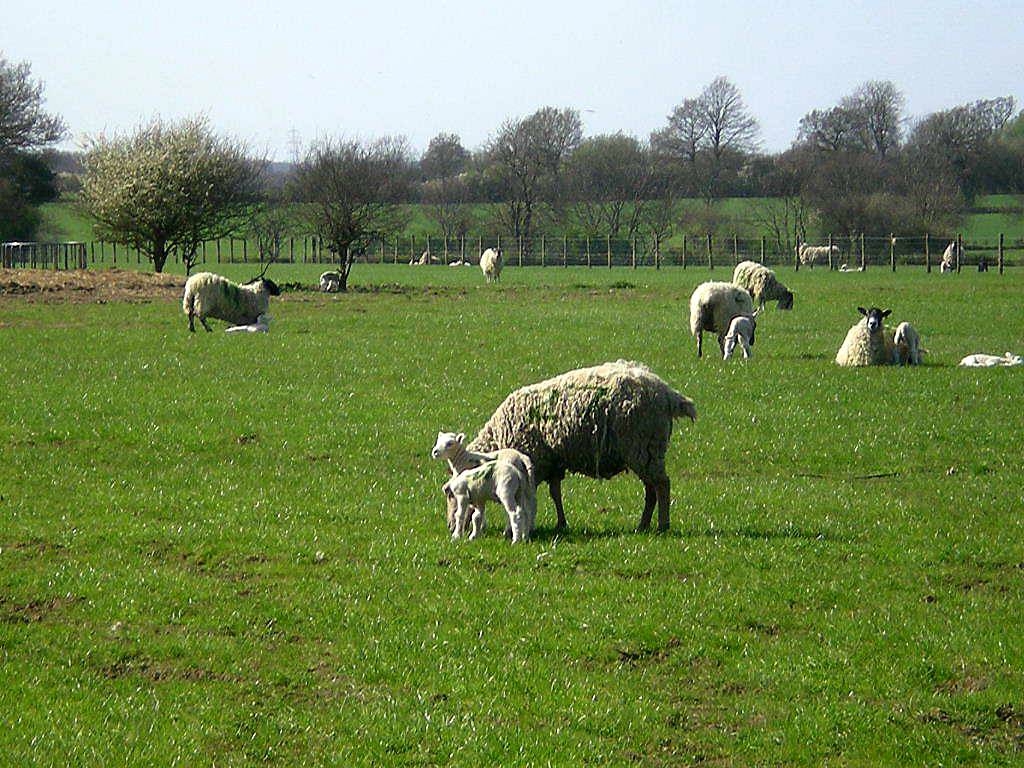
Especially since An Unholy Communion (my working title, but who knows what it will end up as?) deals with elements of the paranormal and Phil Rickman’s wonderful spooky novels have already shown us how sinister those lovely green sheep-covered hillsides can really be.
I make it a hallmark of my writing to try to give my reader a “you are there” experience when developing the background of my novels. And that means being there myself first. I try never to set a scene in a place I haven’t actually been myself and never have my characters undergo an experience I haven’t had myself— with the exception of the occasional abduction and stumbling over murdered bodies, you understand.Since, like most of my books, The Monastery Murders are set in Great Britain and I live 7000 miles away in
Boise, Idaho, research can be a considerable challenge. I begin by doing all I can to develop my basic storyline at home from books and internet research. I like to have my plot well outlined and perhaps the first chapter or so of my novel rough drafted. But when I know I’ve gone as far as I can go and I have a good handle on what I still need to know, it’s time for the real fun to begin— on-site research.
Boise, Idaho, research can be a considerable challenge. I begin by doing all I can to develop my basic storyline at home from books and internet research. I like to have my plot well outlined and perhaps the first chapter or so of my novel rough drafted. But when I know I’ve gone as far as I can go and I have a good handle on what I still need to know, it’s time for the real fun to begin— on-site research.In An Unholy Communion Felicity and Antony are leading a youth walk along an ancient Medieval pilgrimage route in southern Wales when what should have been an idyllic ramble with no more than the occasional blister to contend with turns very nasty, indeed. Time to pack my bags.
I was extremely fortunate because my writer friend Dolores Gordon-Smith, whose Jack Haldean mysteries I highly recommend (http://www.doloresgordon-smith.co.uk/) agreed to be my driver and research assistant.
Since the root of the nastiness Felicity and Antony encounter seems to go back to Roman times Dolores and I began by exploring the Roman ruins in Caerleon.
We had no trouble picking up the beginning of the ancient pilgrimage trail in Llantarnam, but finding our way (or at least the pilgrims’ way) over the mountains became more difficult, especially when sheets of rain poured down on us with blasts of wind that nearly blew us off a mountain top in the Rhonda.Undaunted, though we went on to St. David’s on the southwestern tip of Wales where the ruined Bishop’s Palace behind St. David’s Cathedral is an absolute gift to a mystery writer looking for nooks and crannies to hide spies and ancient artifacts.
Not to mention the stunning cliff walk just beyond offering sheer drops to the rocks below with the sea crashing white foam. Dolores pulled me back from too-enthusiastic picture taking over the precipice, but I’m wondering— who will pull Felicity back?
A Very Private Grave, The Monastery Murders
Felicity Howard, a young American studying for the Anglican priesthood at the College of the Transfiguration in Yorkshire, is devastated when she finds her beloved Fr. Dominic brutally murdered and Fr. Antony, her
church history lecturer, soaked in his blood .
church history lecturer, soaked in his blood .A Very Private Grave is a contemporary novel with a thoroughly modern heroine who must learn some ageless truths in order to solve the mystery and save her own life as she and Fr. Antony flee a murderer and follow clues that take them to out-of-the way sites in northern England and southern Scotland. The narrative mixes detection, intellectual puzzles, spiritual aspiration, romance, and the solving of clues ancient and modern.
“With a bludgeoned body in Chapter 1, and a pair of intrepid amateur sleuths, A Very Private Grave qualifies as a traditional mystery. But this is no mere formulaic whodunit: it is a Knickerbocker Glory of a thriller. At its centre is a sweeping, page-turning quest – in the steps of St. Cuthbert – through the atmospherically-depicted North of England, served up with dollops of Church history and lashings of romance. In this novel, Donna Fletcher Crow has created her own niche within the genre of clerical mysteries.” – Kate Charles, author of Deep WatersBio
Donna Fletcher Crow is the author of 36 books, mostly novels dealing with British history. The award-winning GLASTONBURY, an Arthurian grail search epic covering 15 centuries of English history, is her best-known work. A VERY PRIVATE GRAVE, book 1 in the Monastery Murders series is her reentry into publishing after a 10 year hiatus. Book 2 A DARKLY HIDDEN TRUTH will be out in 2011. THE SHADOW OF REALITY, Book 1 The Elizabeth & Richard Mysteries, is a romantic intrigue available on Ebook. A MIDSUMMER EVE’S NIGHTMARE, Book 2 in the Elizabeth & Richard series is her newest release.
Donna and her husband have 4 adult children and 10 grandchildren. She is an enthusiastic gardener. To see the book video for A VERY PRIVATE GRAVE and pictures from Donna’s garden and research trips go to: www.DonnaFletcherCrow.com.
Her blog is at: http://www.donnafletchercrow.com/articles.php and you can follow her on Facebook at: http://ning.it/eLjgYp
Thank you so much, Donna!
You can find out more about Donna and her wonderful mysteries on her website at: http://www.donnafletchercrow.com/ .
Tuesday, April 26, 2011
Getting Ready for Malice Domestic
It's time for the Malice Domestic mystery writers conference in Silver Spring, Maryland! I'm pretty excited about it, but it does mean that for a second week in a row, I'll sort of be "off 'Net". Which can be a good thing. Not to get side-tracked from my main blog, but I remember a few winters ago when we had a severe ice storm that caused us to lose electricity for about 5 days. At first, it was a bit of a hassle, but once we got the old wood stoves cranked up and the generator to run the well pump, it was sort of nice to realize that even if we didn't want to be, we were off the Internet grid. It was a bit of a relief, actually, to be disconnected.
Anyway, I thought I'd just do a quick blog before I go off into the wilds of Silver Spring.
For me, conferences are all about learning. I'm lousy at networking and although there are some wonderful friends I hope to catch up with at the conference, like mystery writer Sandra Parshall (we used to work on the local Audubon society newsletter together many eons ago--right after the earth's crust cooled and the dinosaurs turned into birds) my main goal is to attend some of the fantastic classes.
What classes have caught my beady little eye?
Here's a taste of the exotic and curious fare:
Well, I've got to run. My husband is looming over me, threatening me with a stack of unfolded laundry and I guess I really ought to pack, as well.
I'm off tomorrow! Can't wait!
Anyway, I thought I'd just do a quick blog before I go off into the wilds of Silver Spring.
For me, conferences are all about learning. I'm lousy at networking and although there are some wonderful friends I hope to catch up with at the conference, like mystery writer Sandra Parshall (we used to work on the local Audubon society newsletter together many eons ago--right after the earth's crust cooled and the dinosaurs turned into birds) my main goal is to attend some of the fantastic classes.
What classes have caught my beady little eye?
Here's a taste of the exotic and curious fare:
- Malice 101: An Introduction to all things Malice for First-Time Attendees. Well, yes, although this is not my first writers conference, it is my first Malice conference. And you get to meet a lot of nice people at these sort of intro classes.
- The Poison Lady Presents Elemental Murder: Death by the Periodic Table. The presenter is Luci Zahray. I have to admit as a one-time biology major with a strong interest in poisons (for my mysteries, of course!) this is right up my alley. In fact, for my first mystery, The Vital Principle, I used Agatha Christie's favorite poison, cynanide. (No, I'm not actually giving anything away as you learn that in the third chapter, anyway.)
- Things We Wish We Hadn't Written: Authors With Belated Second Thoughts. Yeah. This is a common problem for me. I almost always regret the titles I give my books, for one thing. And there are things that I write that make me wince when I read them a year later. It's nice to know I'm not alone. Of course, it would be just my luck to go to this and discover that I *am* actually alone in this and that the topic is something else entirely.
- World Building: Making the Past Come Alive. I'm one of the panel for this one, so I sort of have to attend. LOL But I'm actually interested in hearing what the others say about how to write a mystery set in another era without making it hopelessly stuffy or inaccessible to the modern reader.
Tea, Scones, and Death: Murder in the English Countryside. Most of my favorite mysteries are set in England. Don't ask me why. Nonetheless, I can't resist this topic.- Cold Winters, Deadly Nights: Murder in New England. After attending college in Northampton, MA, I can only ask--where else would you kill someone? In a book, of course.
Well, I've got to run. My husband is looming over me, threatening me with a stack of unfolded laundry and I guess I really ought to pack, as well.
I'm off tomorrow! Can't wait!
Labels:
conferences,
Malice Domestic,
mysteries,
Writing,
writing mysteries
Friday, April 22, 2011
Guest Author: Danielle Monsch
I'm pleased to have Danielle Monsch on my blog today, talking about one of my favorite subjects: Embracing Digital. There is a huge revolution underway and I'm glad Dani agreed to talk about it.
EMBRACING DIGITAL
This is an exciting time to be an author.
Others might not use that word, and they would have a point. Other words such as uncertain or terrifying also fit nicely into that sentence, but I choose to look at the good things all this change has brought us.
With the digital revolution has come epubs, and I think that is a great development.
As both a reader and a writer, what I crave most is choice. When it comes to writing, I want to be able to tell the story that comes to my head in the best possible way I can, without worrying about story length or sometimes even subject matter.
When only print existed, this was not a possibility. Stories needed to be this length, structured like this, and in one of these settings. That is all.
As a reader, I like having hundreds of stories all in one gizmo that fits in my purse, and knowing whatever I’m in the mood for, whatever length I need it to be, I have it.
Does this mean I am unaware of the negatives. Of course not. I want to have my stories in print. I want to be able to point to a book on my shelf and tell someone, “Look at the name, that’s me!” I want to do a book signing. Like most authors, I still feel print is the brass ring, and I am so reaching for it.
But all this change is making print nervous. Fewer debut authors are being signed. Mid-list authors are getting pushed to the side. All NY money and energy is seems to be focused on the ones who are already superstars and the occasional vanity book by the latest spoiled society kid or reality TV star.
I’m not unaware of the negatives, but I refuse to look at them. It’s a choice I made when I decided that I wanted to make a career out of writing. I’m going to embrace the positives and run with them.
So I now have a story published with an epub, and I am beyond thrilled. It’s a short story, not a novel, so the only reason this story was ever able to see the light of day is due to the fact epubs exist! How cool is that? Especially as I’m rather fond of this story, and I’m really glad I can share it with people.
And all those other stories in my head that are too short and would never be able to exist in a print only world? Hopefully you all will be seeing those as well, believe me, I’m going to keep writing them!
And those novels that I would love to see in print? Well, signing fewer authors still means authors are being signed, and until the last print publisher closes its doors, I’m going to keep submitting.
What about you? Are you excited over all the change, or are you just chugging antacids daily? I’m giving a copy of my story Loving a Fairy Godmother to one random commenter, so let me know!
Bio
Danielle Monsch is a Romantic Geek Girl Writing in a Fantasy World. You can find her on the web at http://www.daniellemonsch.com/ , www.twitter.com/DaniMonsch , www.facebook.com/DanielleMonsch and email her at Dani@DanielleMonsch.com
Loving a Fairy Godmother is available at Liquid Silver Books at http://bit.ly/Dani_LFG
Blurb:
Tiernan is one of a kind. Beyond the divine dimples, killer blue eyes, and hard muscled body, Tiernan is also the only Fairy Godfather. Most of the Fairy Godmothers have no problem with keeping Tiernan around, but Reina isn’t like most Fairy Godmothers.
Amongst Fairy Godmothers, Reina is the best. Organized, efficient, logical. So why is it when Tiernan is around, all those qualities fly out the window? Reina doesn’t like that one infuriating male makes her lose control, and just wants him gone. Circumstances arise that just might let her get her wish, though not in a way she ever wanted.
Tiernan is given an assignment and told either get a Happily Ever After or he will no longer be a Fairy Godfather. Reina is going with him to supervise, but if Tiernan gets his way, he’ll not only be supervising that luscious stubborn fairy in bed, but also get her to admit Happily Ever Afters also apply to Fairy Godmothers.
Excerpt:
“Godfather Tiernan—”
“You can just call me Tiernan,” he interrupted.
She tried again. “Godfather Tiernan—”
“”Didn’t Sara just tell you that you had to follow my directions?”
That pushed her over the edge. “Do you truly think you are going to secure a HEA when you haven’t been able to do it yet?”
He let out a derisive snort, but immediately realized that was a huge mistake. Her face lost her usual look of annoyance crossed with bemused tolerance, leaving pure ice in its place. “This is why men should not be allowed into the Godmother program. None of you have any respect for Happily Ever Afters.”
“I never said I didn’t believe in HEAs” he began, but she cut him off.
“Every case you’ve been on tells me you don’t believe, or else you would have tried once, just once, to get one!”
His hands slammed on the table as he leaned across it, his face coming inches from hers. “I’ve never tried because I believe in love! Humans need love so much, who the hell was I to screw up two people in love to get them to HEA status? I could never forgive myself if two people in love missed out on each other because of my actions!”
All anger fled her face, and a hesitant, unsure look came over features. “What do you think a HEA is?”
He drew in a deep breath, sitting down once again. “I think happily ever after is a nice way to end a story, but in the world I remember, it’s a waste.”
Her hand was halfway towards him before she seemed to remember their roles, and she pulled it back to her side. “Love is wonderful, but only love alone is incomplete. You can love someone, but they can ultimately not be right for you. Even in love, people can still be led to believe the worst of each other, still hurt each other, still decide they are better without the other,” she began, her words hesitant, as if she was trying to define to herself what it all meant as much as to him. “But the Happily Ever After is so much more. It’s finding your perfect match, love purified, refined, to such an extent that it can never be sundered. With a Happily Ever After, men can achieve greatness, as can all the generations who follow growing up in its shadow.”
“And you think jeopardizing the surety of a love match now is worth it for only the possibility of a Happily Ever After?” he asked, his voice gentle, reverent, wanting nothing to break this intimacy their words were creating.
“I do. In your view, maybe that seems cruel, but in my view, there is no greater tragedy then two people who almost make this connection but fall short in the end.”
Such a hard exterior to cover such a tender heart. “I’m not sure if I can believe as you do,” he said after considering her words. “But I never want Sara... you... to feel as if I let you down. After we get this situation behind us, I want you proud of the job I do.”
And as his breath caught at the rare smile she bestowed upon him just then, he knew all she had to do was keep smiling at him like that, and anything she wanted, whether it be his beliefs or his blood, he would give her.
Her smile faded, and the moment ended. Reina cloaked herself in her position of authority as she handed him the file that had been sitting on her desk. It was already open to show a picture of a blond girl, pretty and vibrant with a mouth full of straight white teeth, all of which was evident even underneath the dirt. “I looked over this case earlier, before I realized what was going on,” she said. “It is a good, solid HEA case. There are several challenges to overcome, but also several sources of help for the client. It is about as perfect as a case can be for this purpose, as evenly balanced as I’ve ever seen. No one can accuse the council of favoring either side. The girl’s name is Cinderella. She lives with an abusive Stepmother and two rotten spoiled stepsisters. She is a very kind, generous girl—though a little too much of a doormat, if you ask me—but outside of that, not really any other character flaws. She is much beloved in her village, children and small animals flock to her daily. In short, we exist to give HEAs to mortals like her.”
Tiernan read the file quickly, then flipped the page and took in the photo of the male who would supply the HEA. “A prince, huh? That’s pretty standard.”
“Indeed, but for the most part, we don’t mess with the classics here.” The pointed look she gave him told him he was one of the exceptions, and she wasn’t necessarily thrilled about it. Ah yes, completely back to normal.
He returned that look with a flirty smile. “I used to serve royalty, Godmother Reina. Believe me when I say, sometimes the large crown is to compensate for something.”
“Oh really? Well, I assume we can say the same thing about your sword, eh, knight?”
Maybe not completely back to normal after all. The second those words passed her lips her eyes went saucer wide, and Tiernan couldn’t say who was more shocked, him or Reina herself. There was no way he was letting this pass. His voice coming out a low growl, he replied, “Why, Reina, I never knew you were interested in the size of my sword. Anytime you want a private viewing, I will be more than happy to oblige.”
---
Thanks, Dani!
EMBRACING DIGITAL
This is an exciting time to be an author.
Others might not use that word, and they would have a point. Other words such as uncertain or terrifying also fit nicely into that sentence, but I choose to look at the good things all this change has brought us.
With the digital revolution has come epubs, and I think that is a great development.
As both a reader and a writer, what I crave most is choice. When it comes to writing, I want to be able to tell the story that comes to my head in the best possible way I can, without worrying about story length or sometimes even subject matter.
When only print existed, this was not a possibility. Stories needed to be this length, structured like this, and in one of these settings. That is all.
As a reader, I like having hundreds of stories all in one gizmo that fits in my purse, and knowing whatever I’m in the mood for, whatever length I need it to be, I have it.
Does this mean I am unaware of the negatives. Of course not. I want to have my stories in print. I want to be able to point to a book on my shelf and tell someone, “Look at the name, that’s me!” I want to do a book signing. Like most authors, I still feel print is the brass ring, and I am so reaching for it.
But all this change is making print nervous. Fewer debut authors are being signed. Mid-list authors are getting pushed to the side. All NY money and energy is seems to be focused on the ones who are already superstars and the occasional vanity book by the latest spoiled society kid or reality TV star.
I’m not unaware of the negatives, but I refuse to look at them. It’s a choice I made when I decided that I wanted to make a career out of writing. I’m going to embrace the positives and run with them.
So I now have a story published with an epub, and I am beyond thrilled. It’s a short story, not a novel, so the only reason this story was ever able to see the light of day is due to the fact epubs exist! How cool is that? Especially as I’m rather fond of this story, and I’m really glad I can share it with people.
And all those other stories in my head that are too short and would never be able to exist in a print only world? Hopefully you all will be seeing those as well, believe me, I’m going to keep writing them!
And those novels that I would love to see in print? Well, signing fewer authors still means authors are being signed, and until the last print publisher closes its doors, I’m going to keep submitting.
What about you? Are you excited over all the change, or are you just chugging antacids daily? I’m giving a copy of my story Loving a Fairy Godmother to one random commenter, so let me know!
Bio
Danielle Monsch is a Romantic Geek Girl Writing in a Fantasy World. You can find her on the web at http://www.daniellemonsch.com/ , www.twitter.com/DaniMonsch , www.facebook.com/DanielleMonsch and email her at Dani@DanielleMonsch.com
Loving a Fairy Godmother is available at Liquid Silver Books at http://bit.ly/Dani_LFG
LOVING A FAIRY GODMOTHER
Blurb:
Tiernan is one of a kind. Beyond the divine dimples, killer blue eyes, and hard muscled body, Tiernan is also the only Fairy Godfather. Most of the Fairy Godmothers have no problem with keeping Tiernan around, but Reina isn’t like most Fairy Godmothers.
Amongst Fairy Godmothers, Reina is the best. Organized, efficient, logical. So why is it when Tiernan is around, all those qualities fly out the window? Reina doesn’t like that one infuriating male makes her lose control, and just wants him gone. Circumstances arise that just might let her get her wish, though not in a way she ever wanted.
Tiernan is given an assignment and told either get a Happily Ever After or he will no longer be a Fairy Godfather. Reina is going with him to supervise, but if Tiernan gets his way, he’ll not only be supervising that luscious stubborn fairy in bed, but also get her to admit Happily Ever Afters also apply to Fairy Godmothers.
Excerpt:
“Godfather Tiernan—”
“You can just call me Tiernan,” he interrupted.
She tried again. “Godfather Tiernan—”
“”Didn’t Sara just tell you that you had to follow my directions?”
That pushed her over the edge. “Do you truly think you are going to secure a HEA when you haven’t been able to do it yet?”
He let out a derisive snort, but immediately realized that was a huge mistake. Her face lost her usual look of annoyance crossed with bemused tolerance, leaving pure ice in its place. “This is why men should not be allowed into the Godmother program. None of you have any respect for Happily Ever Afters.”
“I never said I didn’t believe in HEAs” he began, but she cut him off.
“Every case you’ve been on tells me you don’t believe, or else you would have tried once, just once, to get one!”
His hands slammed on the table as he leaned across it, his face coming inches from hers. “I’ve never tried because I believe in love! Humans need love so much, who the hell was I to screw up two people in love to get them to HEA status? I could never forgive myself if two people in love missed out on each other because of my actions!”
All anger fled her face, and a hesitant, unsure look came over features. “What do you think a HEA is?”
He drew in a deep breath, sitting down once again. “I think happily ever after is a nice way to end a story, but in the world I remember, it’s a waste.”
Her hand was halfway towards him before she seemed to remember their roles, and she pulled it back to her side. “Love is wonderful, but only love alone is incomplete. You can love someone, but they can ultimately not be right for you. Even in love, people can still be led to believe the worst of each other, still hurt each other, still decide they are better without the other,” she began, her words hesitant, as if she was trying to define to herself what it all meant as much as to him. “But the Happily Ever After is so much more. It’s finding your perfect match, love purified, refined, to such an extent that it can never be sundered. With a Happily Ever After, men can achieve greatness, as can all the generations who follow growing up in its shadow.”
“And you think jeopardizing the surety of a love match now is worth it for only the possibility of a Happily Ever After?” he asked, his voice gentle, reverent, wanting nothing to break this intimacy their words were creating.
“I do. In your view, maybe that seems cruel, but in my view, there is no greater tragedy then two people who almost make this connection but fall short in the end.”
Such a hard exterior to cover such a tender heart. “I’m not sure if I can believe as you do,” he said after considering her words. “But I never want Sara... you... to feel as if I let you down. After we get this situation behind us, I want you proud of the job I do.”
And as his breath caught at the rare smile she bestowed upon him just then, he knew all she had to do was keep smiling at him like that, and anything she wanted, whether it be his beliefs or his blood, he would give her.
Her smile faded, and the moment ended. Reina cloaked herself in her position of authority as she handed him the file that had been sitting on her desk. It was already open to show a picture of a blond girl, pretty and vibrant with a mouth full of straight white teeth, all of which was evident even underneath the dirt. “I looked over this case earlier, before I realized what was going on,” she said. “It is a good, solid HEA case. There are several challenges to overcome, but also several sources of help for the client. It is about as perfect as a case can be for this purpose, as evenly balanced as I’ve ever seen. No one can accuse the council of favoring either side. The girl’s name is Cinderella. She lives with an abusive Stepmother and two rotten spoiled stepsisters. She is a very kind, generous girl—though a little too much of a doormat, if you ask me—but outside of that, not really any other character flaws. She is much beloved in her village, children and small animals flock to her daily. In short, we exist to give HEAs to mortals like her.”
Tiernan read the file quickly, then flipped the page and took in the photo of the male who would supply the HEA. “A prince, huh? That’s pretty standard.”
“Indeed, but for the most part, we don’t mess with the classics here.” The pointed look she gave him told him he was one of the exceptions, and she wasn’t necessarily thrilled about it. Ah yes, completely back to normal.
He returned that look with a flirty smile. “I used to serve royalty, Godmother Reina. Believe me when I say, sometimes the large crown is to compensate for something.”
“Oh really? Well, I assume we can say the same thing about your sword, eh, knight?”
Maybe not completely back to normal after all. The second those words passed her lips her eyes went saucer wide, and Tiernan couldn’t say who was more shocked, him or Reina herself. There was no way he was letting this pass. His voice coming out a low growl, he replied, “Why, Reina, I never knew you were interested in the size of my sword. Anytime you want a private viewing, I will be more than happy to oblige.”
---
Thanks, Dani!
Sunday, April 17, 2011
Sample Sunday: The Vital Principle
It's a lovely Sunday morning here in North Carolina and I'm offering a small sample from my latest book, a historical mystery called The Vital Principle. Just a small bit to enjoy with your Sunday coffee and muffin.
The Vital Principle is a historical mystery featuring The Second Sons Inquiry Agency. It's been released at a special introductory price of $.99.
The Vital Principle
Backcover
In 1815, an inquiry agent, Mr. Knighton Gaunt, is asked by Lord Crowley to attend a séance with the express purpose of revealing the spiritualist as a fraud. When the séance ends abruptly, Lord Crowley is poisoned during the turmoil by an unseen killer.
Gaunt is now left to investigate not only fraud, but murder. Suspicion turns first to the spiritualist, Miss Prudence Barnard, but as Gaunt digs deeper into the twisted history of the guests at Rosecrest, he discovers more deadly secrets. Inevitably, long-time friends turn against one another as the tension mounts, and Gaunt is challenged to separate fact from fiction before another death at Rosecrest.
The Vital Principle is the first mystery in the Second Sons Inquiry Agency series and features coolly intellectual Mr. Knighton Gaunt, the agency’s founder. This witty, historical whodunit in the tradition of Bruce Alexander’s Blind Justice, will keep you guessing until the unexpected end.
“Murder, mystery, and a dash of romance combined with witty dialogue and unforgettable characters make The Vital Principle a book that will definitely go on my keeper shelf!” —Lilly Gayle, author of Into the Darkness and Slightly Tarnished.
Excerpt
In this excerpt, Miss Barnard is questioned about her possible role in the murder of her host. She's an outsider in a close group of friends and finds herself in the unfortunate position of being the easiest target.
As if aware of her scrutiny, Mr. Gaunt edged closer. He spoke in low tones no one else could hear. “You’re very composed, Miss Barnard.”
“For a murderess? Would tears avail me? Or convince anyone of my innocence?”
“They might. A woman’s tears are often most efficacious.”
“Except when the decision has already been made. A trial seems almost superfluous, doesn’t it?” Her voice was low and biting with anger. A deep feeling of ill-use made it difficult for her to remain calm.
“No one has accused you,” Mr. Gaunt replied. “And if you had a hand in this, you’ll get a fair hearing.”
“Then you do think I murdered Lord Crowley? What possible motive could I have had?”
“For one thing, you didn’t seem pleased when he requested my attendance tonight.”
“I didn’t arrange this entertainment, the dowager did. And it appears to me, the mystery should be why I murdered Lord Crowley instead of simply doing away with you. If you believe I was so upset by your presence.” Frustration and fear compressed her stomach into a cold lump.
“You knew why he asked me here,” he stated flatly.
“Really? Why? Pray enlighten me. I’m all agog to hear.”
“To prove you’re a fraud taking advantage of an elderly widow.”
“Taking advantage? By reassuring the poor dear that whatever silly misdemeanor she believes she committed before her husband died is unimportant? How is that taking advantage of her?”
“You’re better qualified to answer that particular question than I. But I’m sure it’s profitable.”
“Profitable?” She laughed bitterly. When the other men glanced at her, she put her hand over her mouth and turned her inappropriate laughter into a cough. “If you call a frusty little room and a few meals profitable. I’m a guest here, nothing more.” Then she added with a coldly sweet smile, “Guests aren’t paid. Or weren’t you aware of that?”
“So kindness was your only motivation?” His black eyes bored into hers. “How can we trust what you say when you conduct these ridiculous entertainments and pretend to speak to the dead?”
She arched a mocking eyebrow. “What makes you think I can’t?”
“Come now. You can’t expect me to believe you’re capable of communicating with the spirit world. Or that you even believe such a thing is possible.”
“I believe there are many things we don’t understand. I refuse to close my mind to the possibility simply because it’s difficult to prove,” she temporized, knowing only too well the dangers of trying to argue about spirit communications.
If there wasn’t a spirit world, then she’d be forced to acknowledge that she was a complete fraud. And even though she hadn't, yet, reached that unseen world and had used a number of tricks to suggest that she had, she always hoped that one day some apparition might answer her call. There was always the possibility.
Mr. Gaunt smiled and his expression grew even more sardonic. “Then let’s be more specific and examine what we can prove. Did you speak to the dowager’s previous husband?”
“Perhaps not this evening. However, I’m sure the words I wrote were what he would have relayed, if he could have done so.”
“So you lied—”
“No, I merely—”
“It was not the truth!” His lips thinned and anger ignited a slow burning fire in his eyes. “Her husband did not speak through you. Admit it.”
She tilted her head to one side, examining him. “Do you believe her husband did not love her?”
“I have no idea. That’s not the point.”
“Then you don’t know if it was the truth or not.” She offered, instinctively knowing the men would tear her apart like a pack of hungry dogs if she reacted emotionally. Her mind raced ahead, abnormally clear, encased in the fragile ice of logic that could shatter at any moment and leave her raging at their accusations. “And it eased the dowager’s mind. So I fail to see I did anything wrong.”
Mr. Gaunt said, “You mislead—”
“No. I told a desperately lonely woman what she needed to hear. That’s the sum of it. There are many truths. You have yours. I have mine.”
“There is only one truth.”
“Nonsense.” She folded her hands at her waist and turned partially away, unable to bear the intense scrutiny of his hard eyes. Her fingers felt stiff and icy with fear. “I refuse to discuss this any further. It’s futile. You’ll believe what you wish. If you chose not to trust me, then so be it. But regardless of what you think, I did not kill Lord Crowley.”
-------
Thank you,
Amy
http://www.amycorwin.com/
The Vital Principle is a historical mystery featuring The Second Sons Inquiry Agency. It's been released at a special introductory price of $.99.
The Vital Principle
Backcover
In 1815, an inquiry agent, Mr. Knighton Gaunt, is asked by Lord Crowley to attend a séance with the express purpose of revealing the spiritualist as a fraud. When the séance ends abruptly, Lord Crowley is poisoned during the turmoil by an unseen killer.
Gaunt is now left to investigate not only fraud, but murder. Suspicion turns first to the spiritualist, Miss Prudence Barnard, but as Gaunt digs deeper into the twisted history of the guests at Rosecrest, he discovers more deadly secrets. Inevitably, long-time friends turn against one another as the tension mounts, and Gaunt is challenged to separate fact from fiction before another death at Rosecrest.
The Vital Principle is the first mystery in the Second Sons Inquiry Agency series and features coolly intellectual Mr. Knighton Gaunt, the agency’s founder. This witty, historical whodunit in the tradition of Bruce Alexander’s Blind Justice, will keep you guessing until the unexpected end.
“Murder, mystery, and a dash of romance combined with witty dialogue and unforgettable characters make The Vital Principle a book that will definitely go on my keeper shelf!” —Lilly Gayle, author of Into the Darkness and Slightly Tarnished.
Excerpt
In this excerpt, Miss Barnard is questioned about her possible role in the murder of her host. She's an outsider in a close group of friends and finds herself in the unfortunate position of being the easiest target.
As if aware of her scrutiny, Mr. Gaunt edged closer. He spoke in low tones no one else could hear. “You’re very composed, Miss Barnard.”
“For a murderess? Would tears avail me? Or convince anyone of my innocence?”
“They might. A woman’s tears are often most efficacious.”
“Except when the decision has already been made. A trial seems almost superfluous, doesn’t it?” Her voice was low and biting with anger. A deep feeling of ill-use made it difficult for her to remain calm.
“No one has accused you,” Mr. Gaunt replied. “And if you had a hand in this, you’ll get a fair hearing.”
“Then you do think I murdered Lord Crowley? What possible motive could I have had?”
“For one thing, you didn’t seem pleased when he requested my attendance tonight.”
“I didn’t arrange this entertainment, the dowager did. And it appears to me, the mystery should be why I murdered Lord Crowley instead of simply doing away with you. If you believe I was so upset by your presence.” Frustration and fear compressed her stomach into a cold lump.
“You knew why he asked me here,” he stated flatly.
“Really? Why? Pray enlighten me. I’m all agog to hear.”
“To prove you’re a fraud taking advantage of an elderly widow.”
“Taking advantage? By reassuring the poor dear that whatever silly misdemeanor she believes she committed before her husband died is unimportant? How is that taking advantage of her?”
“You’re better qualified to answer that particular question than I. But I’m sure it’s profitable.”
“Profitable?” She laughed bitterly. When the other men glanced at her, she put her hand over her mouth and turned her inappropriate laughter into a cough. “If you call a frusty little room and a few meals profitable. I’m a guest here, nothing more.” Then she added with a coldly sweet smile, “Guests aren’t paid. Or weren’t you aware of that?”
“So kindness was your only motivation?” His black eyes bored into hers. “How can we trust what you say when you conduct these ridiculous entertainments and pretend to speak to the dead?”
She arched a mocking eyebrow. “What makes you think I can’t?”
“Come now. You can’t expect me to believe you’re capable of communicating with the spirit world. Or that you even believe such a thing is possible.”
“I believe there are many things we don’t understand. I refuse to close my mind to the possibility simply because it’s difficult to prove,” she temporized, knowing only too well the dangers of trying to argue about spirit communications.
If there wasn’t a spirit world, then she’d be forced to acknowledge that she was a complete fraud. And even though she hadn't, yet, reached that unseen world and had used a number of tricks to suggest that she had, she always hoped that one day some apparition might answer her call. There was always the possibility.
Mr. Gaunt smiled and his expression grew even more sardonic. “Then let’s be more specific and examine what we can prove. Did you speak to the dowager’s previous husband?”
“Perhaps not this evening. However, I’m sure the words I wrote were what he would have relayed, if he could have done so.”
“So you lied—”
“No, I merely—”
“It was not the truth!” His lips thinned and anger ignited a slow burning fire in his eyes. “Her husband did not speak through you. Admit it.”
She tilted her head to one side, examining him. “Do you believe her husband did not love her?”
“I have no idea. That’s not the point.”
“Then you don’t know if it was the truth or not.” She offered, instinctively knowing the men would tear her apart like a pack of hungry dogs if she reacted emotionally. Her mind raced ahead, abnormally clear, encased in the fragile ice of logic that could shatter at any moment and leave her raging at their accusations. “And it eased the dowager’s mind. So I fail to see I did anything wrong.”
Mr. Gaunt said, “You mislead—”
“No. I told a desperately lonely woman what she needed to hear. That’s the sum of it. There are many truths. You have yours. I have mine.”
“There is only one truth.”
“Nonsense.” She folded her hands at her waist and turned partially away, unable to bear the intense scrutiny of his hard eyes. Her fingers felt stiff and icy with fear. “I refuse to discuss this any further. It’s futile. You’ll believe what you wish. If you chose not to trust me, then so be it. But regardless of what you think, I did not kill Lord Crowley.”
-------
Thank you,
Amy
http://www.amycorwin.com/
Subscribe to:
Comments (Atom)