Fiction Writing and Other Oddities

Tuesday, September 09, 2008

Writing as a Career

Writing is such a strange career: I almost never meet writers who are "comfortable" with where they are.  In my day job, I'm a computer specialist, specifically an Enterprise Administrators managing over 550 domain controllers in 370 sites nation-wide.  And while everyone wants more money, folks are pretty happy with "where they are".  I know that back when I decided writing was a dream job (emphasis on dream) that had little to do with reality, being an Enterprise Administrator was my ultimate goal.

So naturally, having reached that goal, I no longer want it.  Story of my life.  Anyway, I mentioned this computer stuff not to make your eyes glaze over but as a point of comparison.  Because writing, in a lot of ways, is never what you expect, and your goals have a way of morphing into something completely unexpected and nerve-wracking.

When you start out, you just want to write.  You might never care if you get published, the writing is enough.  That's sort of a misty, happy-crappy initial stage.  For some writers, there is no desire or need to progress.  Sigh.

They are the lucky ones.

But for a few, the idea of getting published takes root.  Then really weird things start happening.  Just like the acting world, I've seen the development of "strata" of writers. 

And note, having an agent will make some of the upper strata easier or more possible, but in no way guarantees the writer will ever make it from one strata to the next.  Even having multiple agents doesn't always help.

Night-Writers:  This is the first strata.  They are the equivalent of those actors and actresses who get occasional "gigs" at community theatre or perhaps even a paid, local production.  For writers, this means you have squeaked through the door to publication by smaller publishers, e.g. e-publishers.  You get royalties, but there is no way to live on the money because you may make $50-$300 per book and it may take 6-months to write a book (or a year, in my case).  Hence the term, night-writer.  You have to keep that day job, just like all those wait-folks working in restaurants determined to someday get their big break.

The advantages, however, are that you don't necessarily have to conform to what is popular in fiction.  Publishers are more willing to take a chance on you, since they don't have to pay you an advance up-front.  You can work at your own pace.  You have creative freedom.

The disadvantages are fairly obvious.  You aren't making enough to even receive minimum wage for the time you spent writing your book.  You're responsible for all your own advertising and promotion, which is typically more money out of your pocket and may actually require you to spend money earned at your day job.  Most likely, you won't be able to walk into a bookstore and find your book: they are typically sold via Internet sources, even if your e-book is sold as a paperback.  Not a bad thing, just an ego note.

The Commercials:  So now, the writer has made it to a level that actually pays advances.  These are still smaller publishers, but they do pay advances ranging from $500 to $1000.  Just like actors in commercials--you can earn money, and it's fairly nice money, but not enough to live on.  Unless you can write really, really fast.  Again, if it takes you about 6 months to write a novel (I take about 6 months to a year, or longer) then you may make $2,000.  Still not enough to live on.  At least for me.

The advantages, though, are that you may actually find your book in a few bookstores (ego boost!).  The publisher may do some (small amount) of promotion and may already have some distribution channels which will help you.  They also, typically, don't lock you into a multi-book contract with outrageous deadlines, so you still have some scheduling freedom.  And you may retain fairly good creative freedom, but...maybe not.

Publishers in this range tend to have stricter guidelines about length and types of stories they will publish.  But they will accept manuscripts from writers without agents, so that is a huge plus for some writers who have difficulties finding (or working with) an agent.

The Soaps:  Yeah!  Okay, so you're not a glamourous writer lounging around with a chef, gardener, housekeeper, and two or three hangers-on.  But you have the chance now to actually make a living if you don't mind earning slightly less than those on welfare.  Seriously, many writers consider this "mid-list" or at least a living wage, but if you quit your job, it's best if you're married to someone who is working.

You get multi-book contracts, e.g. a three-book contract.  Just like a soap actor, you have a little job security (unless the soap actor pisses off someone and gets written out of the story).  You get an advance somewhere in the range of $3,000 to $25,000. 

The publisher does a little more in the way of promotion, plus they have distribution channels, so you'll actually find your book in a bookstore.

This is the stage all non-published writers who want to be published aspire to (unless they're totally starry-eyed and think they'll leap right to movie star).  They (often naively) think if they just reach this stage, they'll be all set.  For some, this may be true.

But you know, some folks are just never happy and writers seem to be more angst-ridden than almost any other group of people I've ever meet.  Because so many are at this stage and completely fraught with performance anxiety and other woes.  Which is actually understandable, given the fact that writers when they reach this stage, often (foolishly) give up their day jobs, thinking they have it made.  Or because they have to in order to keep up with the writing schedule imposed upon them by their publisher.

This is where it really does get to be like the soaps.  Because mid-list writers are like actors, slightly nicked by a knife and then thrown into an ocean of sharks and told to pretend to be terrified.  The camera is rolling.  They could be "written out" at any moment and be swallowed up again into relative obscurity. 

The advantages are that you're finally able to--possibly--make a living.  The disadvantages however, really start to be noticeable, just like those sharks.  You now have to meet a schedule imposed by your publisher.  This can be a huge problem for folks who take a little longer to write and polish a book. 

There is no guarantee of a follow-on contract.  Each contract is a separate negotiation and future contracts may depend *gulp* upon how well your previous books sold.  This means that pretty much each book needs to be better than the last.  Not as easy as it sounds.  Your muse needs to buckle down and write every day, regardless of physical or emotional trauma.  And having a multi-book contract does not mean they will automatically accept your second or third book.  They may decide it doesn't work for them and that's the end of the contract.

Or, you can wake up to find whatever genre you wrote is no longer selling and no publishers will even talk to you.  Your agent may give you a nice kiss on the cheek, a pat on the head, and a goodbye forever (except to get those royalty checks on past sales).

Talk about performance anxiety.  You have to fight for every scrap.

The Movie Stars: We all know these folks.  As a writer, you can become a movie star with your first book, a la Allison Brennan, or you can work your way up like Jennifer Crusie.  Regardless, at this level, you have an agent.  You have no other job.  Your mere name brings dollar signs to the eyes of agents and publishers.

At least for a while.

If you think all worries are over at this point, you are sadly mistaken.  One bad book can be forgiven.  Two bad books...maybe forgiven.  But three? Hmmm.  Four?  Well, sweetie.  There are always the soaps.  Or commercials.

In fact, nothing is certain at any stage, except:

 *  What you write tomorrow must be better than what you wrote today.

*  You'll never be completely free of neurosis.

*  You'll never know if/when you'll get that next contract.

But you know what?  While writing may make eventually me crazy, if I don't write, I am crazy.

Tuesday, August 26, 2008

Nostalgia


It's birthday time for all of us Virgo folks and despite my best efforts to dissuade people from even mentioning it, I was lucky this year. My husband got me a sewing machine because my old Pfaff bit the big one and I was using my mother's machine from the 1950's but many of the rubber pieces on it are crumbling. I'm very happy he caught my comment about my desire for a new machine before they became scarcer than hen's teeth. Seems no one sews anymore.


To my shock and dismay, even Wal-Mart is getting out of the sewing and fabric business so I'm not sure where I'll find supplies, but I'm going to keep on as long as I can. I don't sew a lot anymore--who has the time? But I do have a pressing need to sew. I've discovered that if I make very, very wide-legged long pants out of light fabric, I can stave off the ravages of summer rashes. Even a blade of grass brushing against my ankles in the summer will leave long red streaks that blister and itch for a month afterwards. I'd say I have sensitive skin, but that makes me sound like something out of Princess and the Pea, when it's more like something you'd find on one of those late night medical shows. 'Nuff said about that unpleasant topic.


At least I have my new sewing machine!


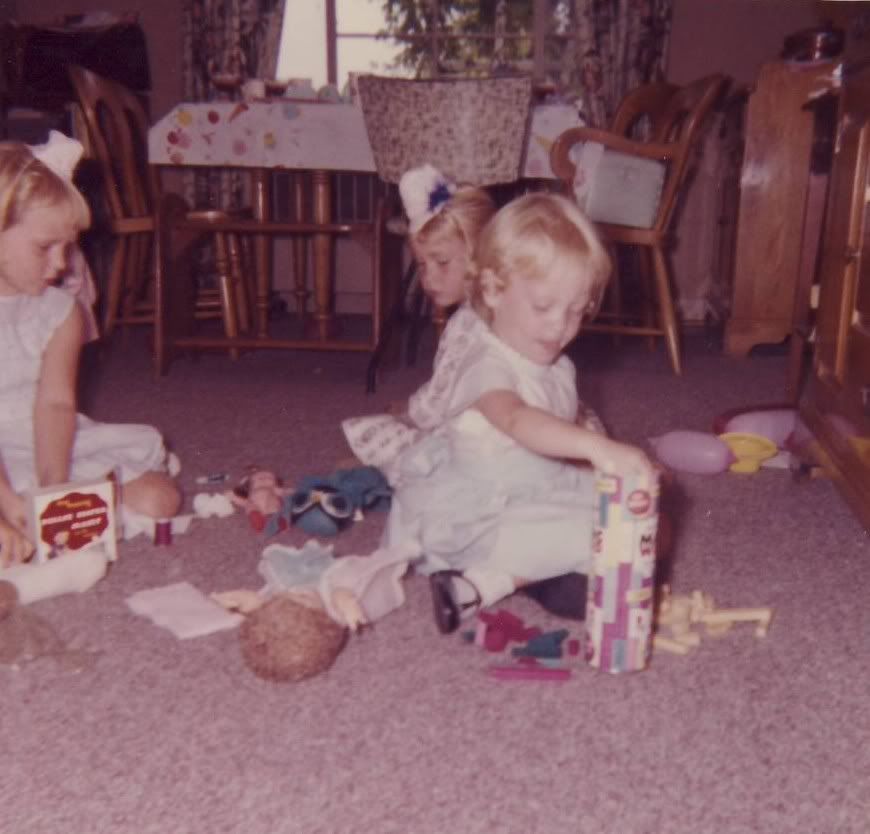
And my sister really got me where it counts. She took our really old 8mm film and had some video place put them on DVD. It is so incredible to watch ourselves as children--and my mom and dad, who passed away about ten years ago. Those DVD are the greatest gift of all, I think.


This evening I played around with ripping the DVD to my computer's hard drive (it worked) and I purchased a utility which then lets me convert the files to standard mpeg (or other types of movie files). Once I do that, I can "be my own producer" and clip out a few to put up on YouTube. Not that I think there will be a lot of folks interested in watching a couple of kids running around with hamsters, a duck, and a boat-load of Christmas presents... But I enjoy watching other folks' videos, so why not?


And amazing how much work my parents and grandparents put into holidays for us--and we didn't even truly appreciate it (until now). My grandfather made doll beds and furniture out of scraps for our dolls while mom and grandma made Raggedy Ann & Andy dolls, and entire wardrobes for our Barbies and other dolls. Not to mention matching outfits for my sister and me. Our dolls were better dressed than most kids--even if all those clothes were made from remnants from the curtains, table-clothes and upholstery my mom and dad happened to be working on. Mom and grandma sewed constantly. Now I know why, and I can see why that sewing machine meant so much to me.


So here's to nostalgia, birthdays, and getting that happy, weepy feeling over silly things like old movies and sewing machines.


Tuesday, August 19, 2008

Random Good News

Despite all the overtime and aggravation at my "regular job" this week has held some really nice goodies for me.  My lovely and talented editor, Nicola, has created the cover for my new short story, Outrageous Behavior, and we've even gone through the first round of edits.  I know that "going through the first round of edits" sounds mind-boggling horrible, but I actually like it.  I'm weird.  But I get this feeling of progress when I go through them, especially if the edits are light.

And even when the edits are deeper, I still sort of like it, because it's a challenge that I feel I can rise to meet.  I can do this.  In short, it makes me feel competent, which is a nice feeling to get once in a while, rare though that is.

So...here is the really nice cover Nicola made for my short story--I particularly like the fish.  Fishing actually does have meaning--a fun meaning--in the story and it makes it a little different.

And after all, there are very few ills that fishing cannot solve.


I've been toying with the blurb for this story.  So far, I'm thinking along the following track.

As the Season in London comes to a close, Laura finds herself in a predicament. The one man she is attracted to has neglected to make an offer for her, and her family wants her to accept the proposal of a fortune-hunter. Determined not to let propriety stand in the way of her future happiness, she resorts to outrageous behavior to escape the damp grasp of the wrong man—and discover true love in the arms of another.

Nothing is set in stone, but it does rather describe the story in a nutshell.

Then, after I got my edits and cover, I also got the grand news from Writers and Readers of Distinctive Fiction that my blurb for my Regency romantic mystery, I BID ONE AMERICAN, won their contest!  Yippee!  That was nice.  Especially since I struggled a lot with that blurb, trying to capture the essence of what is basically a Regency "romp" with a mystery sub-plot.  Writing those blasted things is a lot more difficult than you might think.

But writers really need to master the art of writing that brilliant, 100-word, blurb that will sell their book, because that is pretty much what you want to put in your query letter, as well.  That is, the letter you send to a prospective agent or publisher, tantalizing them into requesting your partial or full manuscript.  If that simple paragraph captures their interest, chances are good it will also capture the interest of readers.

Or at least that's my theory until someone hits me over the head with completely undesired facts.

Oh, and did I mention that I sold my Christmas novella, Christmas Mishaps, to Cerridwen Press for their Regency anthology?  I can relax now until around October when I'll get the edits for that beast.

In the meantime, I'm polishing up a traditional Regency (no mystery this time, sorry) called, LOVE, THE CRITIC, to send to Cerridwen Press and another Regency romantic mystery called, THE NECKLACE, to send to The Wild Rose Press.

I also have another Regency short story, ROSE WARS, that I'm torn on.  I'll either send it to The Wild Rose Press for their "free story" program as a sort of advertisement for my writing, or sell it as a short story.  That's a tough decision.  At the moment, I'm leaning toward freebie, though.  Just because it might be a nice way to rope in a few more readers.  :-)

And I've submitted a Regency mystery, THE VITAL PRINCIPLE, to a few places, so I'm keeping my fingers crossed on that one.  It's a bit of a pecular mystery, but I enjoyed writing it so I'm hoping to find a home for it.

An agent is still studying THE BRICKLAYER'S HELPER, another Regency romantic mystery. 

Wow--I've got quite a few manuscripts out there in the wilds.  Let's hope a few of them find places to roost.

And I'm getting used to my eeePC.  It's got a few gotchas that I ran into--probably because I'm a computer geek and tried some things that a normal person wouldn't--but on the whole I am very pleased with it.  In fact, I completed my edits on my short story on it, and am plowing through edits on LOVE, THE CRITIC now, so it is already earning its keep.

I feel like I'm forgetting something that I wanted to add to this blog, but I can't quite think of it at the moment.  On the whole, though, the week is starting out fairly well.  I've got to get to bed early, though, because I've shifted my overtime to an early morning slot, hoping it wouldn't be as bad as late evening.  The jury is still out on that one, though.

Good night and pleasant dreams!

Tuesday, August 12, 2008

Technology and Writers

Finally got my cute little eeePC and I'm using it right now to write this blog.  It is going to take some getting used to, especially the keyboard.  While the keyboard is 95% of the size of a normal keyboard, it feels a little smaller :-).  But then, I don't have very slender, small, lady-like hands, either. 

If I were to travel back in time, based upon my hands and feet, there would be no doubt that I was--or am--a peasant.

That notwithstanding, I can always get an external keyboard if this one drives me crazy.  I think I can get used to it, though.  Besides that, I have had a few glitches.  Nothing the eeePC wikis couldn't walk me through--but I did lose my file manager icon at one point and the networking goes in and out.  Probably need to update more of the software.

I did manage, though, to connect to my big guy PC and access my manuscripts, so I can edit those babies from anywhere in the house.  (I bought a wireless access point at the same time as the eeePC so I can get to the internet and any PC in my house at any time.  Like I really need to waste more time on the Internet and messing with computers.)

But the big plus is that I now have a device to use when editing my manuscripts on travel!  And this little bugger will even fit in my purse (my big purse that looks strangely like a diaper bag--but isn't as I don't have any children unless you count all the animals and my husband.)  Or I can even take it to our cottage.  I no longer have an excuse to be a slacker.  Boohoo.

And I remember my first manuscript--written on an old manual Smith-Corona typewriter.  With carbon paper (to make a duplicate).  Never did sell that one, or the one after it, but it sure made me feel it was serious business when I typed it out because I didn't want to have to go back with a lot of corrections.

I've gotten really lazy lately knowing that I can go back and edit any number of times with very little effort, now.

And speaking of technology and writers--I've yet again been perusing the various writery tools out there.  I'm still most enamored of my little cheapo Anthemion Storylines and Writer's Cafe.  They let you brain storm and even add clip art and pictures with Writer's Cafe, and  then get down to business actually working out the storyline itself with the Storylines piece.  I just wish the two were more tightly integrated so that junk you put into Writer's Cafe could be fed into Storylines.

I have to say, though, after using nearly every product out there for writers, there is nothing any of these packages do that can't be done in your wordprocessor or spreadsheet.  With one notable exception.  They all make you painfully aware of the ELEMENTS of a story and the progression of scene and sequel, building tension, etc.  They make you think out why you want to include a scene, what you're going to accomplish with it, and hopefully make you get rid of anything that doesn't build the story.

Once you learn that process though, well, all the software in the world isn't going to make your job easier.  Because you still have to write the story and edit it.

But I believe I will stick with my Anthemion software-even if it doesn't run on my eeePC.

And guess what my first project will be?  I want to write yet another short story (I'm having fun with them) but this time it will be a murder mystery.  :-) 

Good night and pleasant dreams!

Tuesday, August 05, 2008

Layers of Character

Characterization and writing style completely obsess me both as a reader and a writer.  Like an English Bulldog with its jaws locked on its master's trouser cuff, I just can't let it go.

Recently, I read a book completely out of my normal reading habits.  There is nothing like reading something you wouldn't ordinarily pick up to make you see things from a different perspective.  On the one hand, this book gave me new insights into techniques for characterization and description that didn't end up in purple prose haze.  On the other hand, it raised that nasty old spectre of inadequacy (mine, not the author's) and envy:  Why can't I write like that?

What was I reading, you ask?  And what insights did I gain (other than utter despair)?

I'll tell you.

"Rumors" by Anna Godbersen.

I normally don't read things that aren't guaranteed to have a complete ending and a happy ending.  I, frankly, just don't like series because I don't like loose ends.  I have enough stress on my day job (as you all know by now having becoming familiar with my updates and fairly continual whining) without reading things that don't end nicely and neatly.  My life isn't neat, and I can't even completely tie up the ends of most projects I'm involved with, so I really don't need that irritant when I read. Which is all, entirely, besides the point.

And while "Rumors" is billed as a book for young adults, I have no clue as to why.  It struck me as literary historical fiction that just happened to have young main characters.  Shrug.  (I'm not here to second-guess the publishing industry's classification system.  That would be good for another blog, though.)

The book is very literary.  In a good way.  The writing is outstanding and smooth--almost exquisite.  And I've rarely seen a writer weave in period details so effortlessly.  You truly fall into that brief, charming era of New York high society in 1899, before the world changed irrevocably with the World Wars.

The way Godbersen can draw pictures without resorting to slushy purple prose is truly amazing. No heaving bosoms, fiery red hair, and flashing emerald eyes in this book.

And what struck me most of all, though, was her characterization.  It exemplified a couple of things I wanted to note.

Let me give you two examples of passages about one of the main characters called Penelope.  In this scene, Penelope is part of a group of wealthy Society folks handing out Christmas turkeys to the poor.

Even through her dogskin gloves and a layer of newspaper wrapping, she could feel the cold squishiness of the bird.  It was heavy and awkward in her hands, and she tried not to show any signs of revulsion as she moved forward with the promised Christmas turkey.

That's one of those little passages that makes you start really considering Penelope.  There were a few others before this where you were starting to wonder about her personality.  Then a few paragraphs later:

...But Penelope thought her hands were superior, and so preferred to change gloves ten or eleven times.  She never wore the same pair twice, though her recently discovered virtue had inspired her to donate them occasionally.

Yeah.  What a peach of a girl.

Nowhere does the author sit down and tell the reader that Penelope is a spoiled-rotten, two-faced, manipulative bee-itch, but a few more paragraphs like the above and you know.  You KNOW--without being told.

And that's the point.  So many writers forget that characters are built from thoughts, feelings, and actions in the story.  Layer upon layer.  There is no instant characterization--it is done by revelation of the layers of action and the characters thoughts/feelings. 

Some writers try to tell us who a character is and what she is like by having another character describe her.  The author is attempting a shortcut, for example when she has the hero say, "She may be a pain in the butt, but she's smart and I trust her judgment."

That statement by the hero does not make the heroine smart, nor will the reader automatically trust the heroine's judgment if the heroine then proceeds to do a lot of dumb stuff (like walking down into the dark cellar where she knows the killer is awaiting her).  We (the readers) will just conclude the hero is at a minimum a bad judge of character and at worst, a complete slack-jawed, drooling idiot.

Characterization is hard work--really, really hard work--even if Godbersen makes it look ridiculously easy.  It is something I struggle with as a writer because my preference is to write a log of dialog--most of it funny/snarky--and just a dash of very abbreviated action and even less description.  But that's no way to create lasting characters.  You've got to have those layers and you've got to use those layers to show, bit by bit, how the character would act in a specific set of circumstances and in a way that only that character would act.  And reveal why they are acting in that fashion and how the character feels about it.

It's very complicated and very hard.

But as a reader, I know I have no patience for books that try to do an end-run around layered characterization.  So it's gotta be important.

Friday, August 01, 2008

Guest Blogger: Nancy Hunter

Sometimes it's fun to "cross-pollinate" with other writers and give folks a chance to read ramblings from a slightly different, albeit still twisted, mind.  (All writers have twisted minds--we have to in order to write.)

Today I'm sharing my blog space with a fellow writer from Cerridwen Press, Nancy Hunter!  She has a new book out, and the following is a tantalizing glimpse of Taste of Liberty.

Book Info:

Taste of Liberty

by Nancy Hunter

Cerridwen Press

ISBN:  978 14199 17394


Blurb:

In a time of war and loss, tragedy unites two enemies who seek vengeance but find love, only to learn that it was never their destiny to be together…

Liberty MacRae, daughter of an American Revolutionary, and Sebastian Cole, a British soldier, share a vendetta against the brutal British commander who killed their loved ones. Each brings a special gift to their quest – Liberty has a second sight that allows her to predict death, and Sebastian is a Fated One, a man who died before he could kill his enemy and has been sent back by the spirits to complete the task. When they fall in love, they have to find a way to defeat not only the murderer, but destiny as well - a destiny that demands that Sebastian either forfeit his life to defeat his enemy or forfeit his soul. Can they find a way to change their destiny before Liberty's most harrowing premonition - that of her lover's death - comes true?

Excerpt:

Libbie would have screamed but her throat was frozen in fear. Death had hurled itself at her, had stumbled, had— Landed in an azalea bush? She was still shaking, still felt the cold fear curled in the pit of her belly but the bright strands of red hanging in the air had dissipated. The death that had lurked just beyond Lady Jane's garden was no longer there. And the creature who had frightened her beyond reason and was now struggling to right himself looked uncannily like one of her dinner companions.

Libbie shook again but this time with laughter. She wiped away the tears that had begun to dry on her cheeks. With the threat gone, she felt light again and joyful and invincible. She reached down into the azalea bush and grasped Mr. Cole's hand to help him stand.

"Miss MacRae, are you hurt? I'm so sorry, I didn't see you there." He stopped to catch his breath.

Libbie covered her smile with one hand and nodded. "I'm fine," she finally managed to say. "I daresay you bore the brunt of our unfortunate encounter."

He was breathing normally now. "I do apologize for that. It's just that I heard a noise and I…" He shook his head.

Libbie took a step back from him, hoping to shrink into the shadows. He had heard her crying like a baby, like a lunatic driven insane by the full moon. Like the aberration of nature that she was. But somehow she didn't want Mr. Cole to know the truth about her, to believe anything bad about her at all. It wasn't just that he was handsome, although he truly was. His black hair shimmered in the moonlight, his dark blue eyes were so wide and intense that she felt she could fall into them. He was much taller than she, broad-shouldered and lean. A sleek black panther, tense and still but ready to spring into action at any second.

"Miss MacRae?"

Libbie realized he was proffering his arm to her.

"I asked if I may escort you back to the party."

She nodded and took his arm. As they walked slowly up the garden path, Libbie struggled to find a reason to explain her previous state.

"Were you lost?" Mr. Cole asked quietly.

"Pardon me?"

"On the garden path. I thought you might have been lost, trying to find your way back to the house."

"Yes, I was… I mean, I got turned around on the path." She smiled up at him. She wanted to throw her arms around his neck, to kiss him and thank him for not making her explain herself as she so often had to do. To kiss him…

"Here we are," he said as they stepped onto the veranda. "I wonder if I might ask one favor of you, Miss MacRae."

"Anything," she said quickly, then blushed.

Mr. Cole smiled. "It seems you stepped outside just before we were to share a dance."

Yes. It all came back to her. She hadn't wanted to dance with him. The things he'd made her feel, even from across the room when she'd first seen him, the touch of his hand as he escorted her to dinner, the sound of his laughter as he sat next to her. Something about Mr. Cole made her want to say and do strange things, like kiss him in the garden and dance with him on the veranda. But then he had mentioned her father…

He stepped back from her and stood in position for their dance. Libbie decided she had been overreacting to an innocent comment and obligingly curtsied to him as he bowed to her. They started a minuet, one Libbie had danced dozens of times but she couldn't quite keep the rhythm. The song was slow but she was breathless. As they stepped back and then forward another time, her knees bent under her against her will as another vision pressed in on her. Before she sank to the ground, she felt Sebastian's arms around her waist, pulling her against him, and the vision faded.

"Miss MacRae, are you all right?"

"I'm fine. It's just the heat. It's unseasonably warm this evening, don't you agree?"

"And you had a fright earlier."

"No, I'm fine," she insisted, steadying herself and pushing away from him. "You merely stumbled over me and I've recovered."

"I meant before that. You were afraid of something. You went out into the garden alone and got frightened."

"I go many places alone and I assure you I don't frighten easily."

"Perhaps then you should frighten more easily, because the world can be a very dangerous place."

Libbie widened her eyes in shock. "I'm more aware of that than you'll ever know, Mr. Cole. I've seen things that…"

She looked away from him. It was more than seeing things. It was feeling unbearable pain, reliving deaths died a hundred years ago and yesterday, feeling evil coming but not knowing when or where it would arrive. She looked him in the eye. "I don't need a lecture from you about it."

He grabbed her shoulders and stared at her with the same determination she saw in her father's and brother's faces when they wanted to convince her that she needed their protection. But as she stared up into Sebastian's dark, hooded eyes, his look changed. Determination seemed to give way to confusion, then to resignation as he leaned closer to her. His soft breath brushed her cheek, his fingertips caressed her shoulders. Libbie closed her eyes, willing him to come closer, to actually kiss her.

www.nancyhunterbooks.com

www.myspace.com/nancyhunterbooks

Taste of Liberty available NOW at Cerridwen Press


Tuesday, July 29, 2008

Character Vulnerability

Just got another rejection, sigh, which was pretty devastating because this particular manuscript, THE BRICKLAYER'S HELPER, is particularly near-and-dear to me.  It's one of those rare stories that just flowed and where you felt like you finally got everything right.  The best you've ever written.  And I just love the story.

It's one of those masquerade, murder-mystery, adventure stories laced with a liberal dose of humor.  Or at least that's what I think it is. :-)

Obviously, others disagree, which can be really, really discouraging if you feel that it is the best you've written--or may ever write.  To be honest, it hit me really hard.  It make me think, yet again, about quitting.

Be that as it may.

After a couple of days of thinking about it, I'm thinking I need to do a few tweaks in the first few chapters.  Generally, my biggest flaws are always in the first few chapters.  Once the story gets going, it runs pretty well.  But I have a hard time starting out.  Mostly, I have to completely rip out the first few chapters.

All of this is sort of a digression--in a way.  What I think I really have to do, though, is something I'm always somehow reluctant to do: expose my character's vulnerabilities.  Because this is what makes people reject manuscripts: they don't find the characters compelling.

This is difficult for me as a writer for a number of reasons.

  First and foremost, I feel like my characters do show their vulnerability, but I don't spell it out.  I write something like:  She turned her back on her husband, picked up the cast iron frying pan, and banged it down on the stove.  To me, that clearly shows she is angry.  So I don't want to laboriously explain.  And if this follows an entire scene where she has been arguing with her husband, and if he has said ugly things to her, I also figure the reader will know that the woman is both hurt and angry.

But does the reader really know that?  Perhaps.  Or maybe...not so much.  Even the most astute reader needs a little help now-and-again to interpret actions and even words, because they can generally be taken in multiple ways.  Maybe the woman banged the frying pan down because it was hot.  Or because her wrist gave out.  Maybe she's not angry--she's tired and hurt.

I've finally realized that you do need to insert a few words, here and there, to let the reader know what the characters are feeling.  I've been wary of doing this because I loathe over-writing and am terrified I will become entrapped by flowery, angst-ridden purple-prose.

Unfortunately, my first draft therefore has nothing spelled out.  So I get rejections a lot if I forget this lesson.  Then, I realize my problem and go back in and add bits of emotion...or I try to, but at this point, I also tend to overreact and put in too much navel gazing and explanations.  I have a hard time finding the happy medium.

 My other problem is that frequently, my characters are trying to hide their vulnerabilities and I let them.  So they hide their fears from the reader behind a smart remark and a laugh.

EXPOSE THEIR FEARS.  Big lesson I tend to forget.  One of the best ways to earn reader sympathy for your character is to show some chink in their armor, some vulnerable side, a fear, an Achilles heel.  If your heroine is a tough chick, give her a spider to fear.  Well, that's a bad example because it's totally overused.  But you get the point.

So now I need to go back to The Bricklayer's Helper and just add a sentence or phrase to show poor Sarah's deepest, darkest fear.  She actually has a lot of fear and she's become a master at redirection and suppression, but the dark pit is there within her.  I just have to expose it to give her character depth.  Because she's too good to let go into that long goodnight without putting up a fight to get her story published.

I'm off to the land of rewrites, dictionaries, and angst.

Sweet Dreams!

Tuesday, July 22, 2008

Writing for money or for free?

Another summer is slipping by much too quickly and as usual, I'm getting much less done than I wanted.

What I managed to do, however, was surprise myself by writing a fairly reasonable novella entitled CHRISTMAS MISHAPS for Cerridwen Press' proposed Regency anthology, Cotillion Country Christmas.  My lovely and talented editor approved it and now all that is left is real work: contracts, endless editing, and proofing.

I cannot write quickly, hence my surprise at this accomplishment.  I found out about the project sometime around March and initially had a deadline around June, which normally would be pretty impossible.  Especially considering I had no clue at the time what I would even write.

Not even one idea.

However, as fate would have it, I was reading some Regency-era (early 19th century) magazines I had found on the Internet.  One article talked about a common superstition which stated that if a woman was the first to step over the threshold on Christmas day, she was a harbinger of ill-luck or even death.  As a result, only boys or men were allowed to set foot outside or go visiting in the morning (or as long as it took for some man to set foot over one's threshold).

This odd notion struck my fancy.  So I started a novella about a woman who is estranged from her sister (her sister having run off with the heroine's fiance two years earlier) and wants to make amends.  But she's due to leave London with her parents on Christmas day, so she decides...well, you can pretty much guess, can't you?

Her Christmas day goes downhill from there, including being tormented by a younger man who she suspects is only playing at flirtation.  And she really wishes he wasn't just playing.  And that she wasn't years older than him.

So, anyway, I got about half-way done when I got sidetracked.  And at that point, it looked like the anthology might get sidetracked, too, so I put it aside.  Then, in June, they said:  come on and submit!  Deadline July 14th!

What?  Are you kidding?  After a bit of scrambling, I managed to finish early and submit it.  My editor found a few problems she wanted corrected before (possibly) accepting it, so I made those modifications.  And managed to submit it again in time for the final July deadline.

Apparently it was satisfactory enough for the novella to go to contracting.  This stage always makes me nervous because I fear that something may still happen that will cause the thing to crash-and-burn, but that's where we are.

Only time will tell.

Assuming I'm being paranoid for no reason at all, I'll keep you posted as to the progress and eventual release date of the final product.  I must say, I rather like my little novella and am seriously considering doing a few more shorter works.  Not to mention a longer traditional Regency romance called:  LOVE, THE CRITIC, which I really want to submit to my Cerridwen Press editor--just as soon as my balls grow back and get big enough to submit it after this last round of submissions.

I never have a lot of confidence and what little I can muster is always gone by this stage of the game (i.e. accepted but waiting for contracting, etc).  But maybe by August my editor will be reading through LOVE, THE CRITIC and not imagining all the cruelly torturous punishments I deserve for inflicting such a manuscript on her.

Anyway, back to shorter works of fiction...and writing in general, my other publisher, The Wild Rose Press, has a "free story" program where they publish short works by their authors and give the stories away for free as teasers and promotional material.  (If you haven't checked it out, do so.  After all, it's free.)

I've been thinking hard about this "free story" idea and am still kind of wafflely.

About a month ago, I wrote a short story but put so much into it, I finally submitted it as a regular submission that I will hopefully get paid for.  Because in the back of my mind was another well-known author's advice that if you are a professional and expect to live on your earnings--you must make earnings.  You don't expect a doctor to do your open-heart surgery for free, why would you expect a writer to hand you their story for free?

And if you don't think writing takes just as much time and effort as other careers, you are probably not a professional writer.  That made sense to me.  And I do look on writing as a profession--not a hobby.  A quality product should receive a suitable recompense.

One must live, after all.

On the other hand, I blog for free.  And I do think there might be some value in a short promotional piece that readers can get for free to see if they like your writing.  The problem with that, though, is that you then have to do a good job--which means put a lot of sweat equity into the piece--if you want to impress your readers enough to get them to actually purchase anything else by you.

Which in my mind means spending upwards of a month on a short story, and then giving away all that effort and time, for free.  You can be very sure that Charles Dickens and Edgar Allen Poe never would have considered doing such a thing.  And I'm a little reluctant to de-value my writing by giving it away for free, too.

The other ugly aspect of it is that if you do give your work away for free, you generally can't go back and try to sell it or earn money off of your story.  Most publishers have clauses in their contracts--even short story contracts--that specifically state they won't publish material that has ever been made available to the public for free.

Once free, always free.

In the end, I'm not sure I'll submit the second short story I recently wrote for free, even though that's what I originally intended to do.  I want it to be entertaining, which means spending more time on it.  With enough effort, it should be good enough to draw in more readers for my longer works, like I BID ONE AMERICAN, my Regency romantic mystery. 

But we'll see.  I'm easily persuaded, one might almost say--wafflely--so the fate of my little Regency romance short story, ROSE WARS, is still up in the air.

We'll see which way it falls later this summer (preferably, that waffle will not fall buttered side down).

Good night and pleasant dreams.

Tuesday, July 15, 2008

Historical Accuracy, Phase 2

A few weeks ago I wrote about historical accuracy in my blog. Since I just submitted a historical novella to my editor and am thinking about what to write next, I started contemplating this topic again. I mean, I'm not sure I could even get the details of my own time period accurate, much less those of a period two hundred years ago. And there is that whole TRUTH issue. I'd like to think that there is some sort of TRUTH or FACT that is understandable and knowable, but for most of us, truth and "facts" are largely based upon our perceptions and often limited, or skewed, knowledge.

We do the best we can, but knowledge is like peeling an onion, there is always another layer. There will always be someone who knows more than you do.

You might think I just digressed in discussing THE TRUTH versus perceptions of the truth, but alas, no. Because I'm trying to plot out another historical mystery, and I keep running into decision points or issues.

And that leads me to think about just how accurate I can, or cannot be.

For example, dressing the heroine—or any Regency woman. I've attended several "re-enactment" type affairs where folks who specialize in Regency clothes show what ladies wore and how they got dressed. And they very strongly made the point that a lady simply could not dress herself due to several factors including:

  1. Restricted movement due to corsets, which prevent a lady from reaching behind to fasten up the back of her dress, for example; and
  2. The excessively complex ties, strings, pins (straight or otherwise) used to keep garments together.

Not to mention the discussion about whether Regency women's clothing actually had buttons or not.

The consensus of this group was that no lady could dress herself without help. And a few dresses actually did have a few buttons.

On the other side, several members of the Jane Austen Society have informed me that shy & private Jane used to dress herself. And they don't believe buttons were used on women's dresses (except as decorations) despite the drawing of Jane Austen showing a row of buttons on the back of her dress.

When you think about it, maids and servants often wore the cast-off clothing of their employers. And servants dressed themselves. Ergo, the clothes they got from their employers actually could be thrown on without help or the servants wouldn't have been able to dress themselves in the cast-offs. And please don't remind me that the servants could have altered the clothing. I know. It's all relative.

So…can my ladies dress themselves? Do their dresses have buttons?

I suspect the truth lies somewhere between the two viewpoints. Ladies could dress themselves if they didn't tie their corsets quite so tightly, and a few dresses did, indeed, have a few buttons down the back.

On to my next problem: locale. I just started reading a British mystery—contemporary (more or less—I mean, at least it takes place slightly less than 100 years ago). The author resolved the problem of locale by making up a completely fictional …shire in England with a fictional stately home, and two fictional nearly towns. I like that solution better than my previous ones. I used to pick a small place at random and "en-grandize" it into a name worthy of a territory title (like a Duke's) and so on. Although Georgette Heyer was very good at that, I was less good at picking obscure-enough place names for it not to "rankle" with folks actually from Britain.

So for that—forget the accuracy and go for the completely fictional.

Finally, flora and fauna. You absolutely HAVE to avoid placing rare (undiscovered in that time) plants or hybrids not even created yet in your story. Those just will not do. Nor does it work to name all the flowers you know and have them blooming at the same time, e.g. mums and daffodils. But where I get into the weeds is WHAT TO CALL THINGS?

I'm sitting here with the c. 1808 copy of The Gardener's Calendar, looking at the list of roses. Now, to take a step back, many of the plant names are the same as today, which is great and makes it easy for me to list plants that I know people today will understand. But there are a lot of hybrids or plants that have names that have fallen into disuse and there it is difficult even for an expert to identify exactly which plant is being described.

Roses are notoriously difficult. In this 1808 book, there are many named which could be almost anything. 'Dutch hundred-leaved' could be Centifolia, aka 'Rose of a Hundred Leaves', 'Rose des Peintres', the 'Provence Rose', 'Queen of Roses' and 'Old Cabbage Rose'. Which name do you use?

At one point, I wanted to put a list of the roses grown by the Empress Josephine at Malmaison on my website. Until a rosarian noted that most of them were Gallica roses that are not grown any longer and were lost in the mists of time—not to mention, how would you give the modern reader any reasonable rose names since those rose varieties that still exist are generally known by different names? And there is very little chance of me being able to match the original rose variety name from the list to a modern name that a contemporary person would recognize.

Given that sort of challenge, how can you really paint an accurate picture of the past? Even those who LIVED IN THE PAST couldn't always agree on a consistent name for a rose (hence, Linneaus' universal scheme of names, taxonomy, based on Latin—but even that doesn't address rose varieties since they are not separate species but just hybrids or varieties).

Anyway, enough. I will do my best, knowing that whatever I do, I will get questions from readers that will be perfectly valid—because in truth, truth seems to be more relative than I would like.

And for those who like puzzles, here is a list of roses from 1808:

Early cinnamon; Double yellow; Red monthly; White monthly; Double white; Moss Provence; Common Provence; Double velvet; Single ditto; Dutch hundred-leaved; Blush ditto; Blush Belgick; Red ditto; Marbled; Large royal; York and Lancaster; Red damask; Blush ditto; White damask; Austrian yellow; Double musk; Royal Virgin; Rosa mundi; Frankfort; Cluster-blush; Maiden-blush; Virgin, or thornless; Common red; Burnet-leaved; Scotch, the dwarf; Striped Scotch; Apple-bearing; Single American; Rose of Meux; Pennsylvanian; Red cluster; Burgundy rose.

Note, the spelling and capitalization are from the 1808 book. J

Wednesday, July 02, 2008

Think the Virus, Be the Virus

  Initially, I thought I would blog about my greatness  as a writer and stuff like the fact that Coffee Time Romance has me listed as their featured writer this month.  I've gotten some terrific reviews from a number of reviewers for my latest Regency romantic mystery, I BID ONE AMERICAN, including a lovely item coming out soon from Romance Reviews Today. But despite all of this, I've had sort of a rough week and I'm not up to such shamelessness.

One would think such things would make a writer glow with good feelings and positive energy about their skills.  Instead, it makes me sort of sick and worried about whether I'm any good at all or just a huge sham.  (Wow-Sham! Oh, no, sorry, wrong television ad.  That would be:  Writer-Sham!)

In fact, I'm sitting here wondering what possible reason could I have for considering myself successful as a writer?  I have severe doubts that I am even a decent writer.  Certainly, I'm no Saki. 

And have I ever written anything that a normal human being could understand, much less enjoy?  I don't know.  I mean, if I was a fabulous writer, wouldn't I be on the NYT BestSellers list instead of just my publisher's bestsellers list?  Wouldn't I be #1 on Amazon.com?  Or at least #2?  Wouldn't I have editors begging me for my next book?

Wouldn't I have agents actually putting my name on their rejection letters, instead of "Dear Author"?

Wouldn't I be smart enough not to be writing this in my blog?

So then I started thinking about how it is we writers can go through years (I mean like 30 years) of kicks-in-the-teeth, multiple agents, people telling us our writing stinks, others telling us our writing is capable (ARGH!) but for some incomprehensible reason it's not what we're looking for at the moment...  And I got even more depressed.

What the heck is wrong with us that we keep beating our heads against that wall for little or no gain?  Earning $42 in a year is not going to keep that gas tank filled, kiddo.  Although I guess I'll soon see what "bestselling status" means when my first royalty check floats out of my publisher's hands this fall. 

The point is, though...obviously most of us are not doing it for the money.  In fact--what money?  And we're sure not doing it for an ego boost because I can tell you that I've been kicked so often and so frequently over the last ten years that if there's any ego left I'd sincerely like the wee thing to step forward so I could shake it's microscopic little hand.

This week, I came really, really close to the decision:  maybe I just need to give up.  Maybe I totally stink-on-ice and need to stop inflicting my stuff on others.  I'm just fooling myself with this "I'm a writer" shtick.

I've got a 3" binder full of rejection letters which I can't help saving because I'm completely anal.  Isn't that proof that I'm not a good writer?

So why do I do it?

Why don't I throw in the towel--right now, right this minute?

Who the heck knows?  I sure don't.  No wait--I have this uncomfortable feeling it's because I'm insane.  Completely.  I've got weird stories in my brain that won't leave me alone until I write them down.  And I have this overwhelming urge to communicate.  I don't know what it is--I just have to talk to people, even if it's in writing.

I have to try to explain this world around me and the people in it.  Why do people act the way they do?  Why are we so obstinate?  Why do we take the obviously wrong path?  What the heck is wrong with someone who thinks killing another human being is the answer to any situation--unless of course that person just really, really needs a-killin'.

Don't I get enough people-time and talking at work?  I'm on the phone 7-8 hours a day on conference calls, help calls, planning calls, calls about this-and-that, you name it.  I'm called upon to play amateur psychologist to weed out personal issues from technical computer issues or just listen to some over-worked local site administrator blow off some steam before he goes in and beats some unsuspecting user over the head with their computer monitor.  You'd be surprised what's involved in my job in the way of people skills.  (And I've frequently wondered how many innocent user lives I've actually saved from beatings or worse.)

But really, no one listens to me, anyway, on most of those calls so they're pointless as far as communications go.  And if I get hit by a bus on the way home, those calls are going to buzz on quite nicely without me.  Waves washing over footprints on the beach.  Here for five minutes, gone for eternity.

In a totally strange way, my books are my forum and safety-valve.  Or maybe more like this nice little virus I communicate to others.  They read it and get infected.  Oh, nothing quite fatal.  But something sticks--a scene, a character, a turn of phrase.  And the infection takes hold and spreads as that turn of phrase or idea takes root in the reader, and the reader passes it on to their friends, families, and even enemies.  Maybe especially to enemies.

And so communications takes place.  Insidiously.  Virally.  And despite all the bashings we writers take, we can take pleasure in the fact that yes, even the editor or agent who turned us down was exposed to the virus.  They may even have been infected.  It may stick in their brain until they die. 

And in my case, sooner or later, one of my ideas may pop out of an editor's mouth just as if it was their idea or phrase.  And I have triumphed.

I communicated.  I may have even explained something about the world and its strange inhabitants--at least to myself.

So despite everything, all I can do it keep on trying.  Keep on submitting my projects, and never stop.  Think the virus.  Be the virus.

And if you're a writer, maybe that's the attitude you need to go for, too.  Be the virus.  Write.  And keep on writing until your writing infects enough people to count as a success.  Or die trying under a poorly aimed spray of chlorine disinfectant.

NEVER give up hope.

Sweet dreams.

PS.  I actually feel better now.  Weird how that writing aimless, brainless drivel really does work.  Therapy for the terminally poor and bewildered.

Tuesday, June 24, 2008

The Dilemmas of Historical Fiction

How important is accuracy within a fictional work? This is a point which almost all the writers I know argue. Views range from "not at all" to "it must be as accurate as possible." While I disagree that it is unimportant, I'm well aware that complete accuracy is probably not possible, nor desirable.

Let me state now that this subject tends to be controversial, and what I'm about to write is obviously colored by my own opinions. Nonetheless, I'm hoping to break this down in a way that might help other writers—and readers—make up their minds about what is and is not important to them.

And the good news is that there are published books along the entire continuum. They range from: the only "historical" elements are long dresses, candlelight, and horse-drawn carriages; to "as completely accurate as possible."

That last goal: "to be as completely as possible" is more difficult than you might imagine. Even a writer such as Steven Saylor, who writes mysteries set in ancient Rome, cannot be entirely accurate and still create popular fiction. He often adds notes indicating where he had to "modify history" in order to make it understandable to a modern reader. For example, one of his challenges is time. Up until around the 4th century, B.C., they formally divided day into only two parts: before midday—ante meridian (A.M.); and after midday—post meridian (P.M.). So it's difficult for his characters to talk about time, particularly using modern units of time such as an hour or minute. And yet readers expect some sort of time reference to know how long things take, e.g. did he stand there 5 minutes or 2 hours?

By Seneca's time, 4 B.C. – 65 A.D., the Romans had divided the day into 12 units, "hours," but the thing is, that time was elastic. The day always had exactly 12 hours of daylight no matter if it was a long, summer day, or a short, winter day. So "summer hours" were longer than "winter hours". And that concept sort of hurts my head.

The bottom line is that there are many basic concepts we accept and pretty well believe are "self evident." We think things were "always this way" when in fact the notion may be a relatively modern invention.

But, if you are writing for modern readers, you're going to have to accept a certain amount of anachronisms just to make sense and keep the story moving.

Like a hour being a relatively fixed amount of time.

So, I break this subject—and therefore decisions I make when writing historical fiction—into the following categories:

* Environment. Also called into "world building." This consists of architecture, clothing, furniture, and general props. Even in the most egregiously inaccurate fiction, there is really no excuse for getting these things wrong. There were no steel-and-glass skyscrapers in the 19th century. There were no flying buttresses and Gothic cathedrals in ancient Rome. Unfortunately, there are actually a great many stories where even the basics are just…wrong. This makes me very sad. Because I consider this to be the "minimum" set of things you need to get right to give your historical a sense of being, well, an historical.

* Society, mores and customs. The milieu of the character. This is where even the most fanatical historian can start to drift. Some readers may not even notice errors in this area. And many time periods, such as the Regency, have become so stylized that you may actually be considered to have written a historically inaccurate book if you do not follow the "popular perceptions" of this period.

For the Regency, this includes things like the importance of Almack's to a Regency Miss' social acceptance, or the ease with which a damsel may become "compromised" and forced to marry some hapless male. So this is definitely a grayer area, but note: the more accurate this, the more layers or interest your book can have. And you will often find that this layer forms the major "difference" between mid to lower tier authors and higher tier (esp. literary) authors. Presenting a realistic, complex view of the Society during a specific era can be the thing that makes the difference between ordinary and extraordinary fiction.

* Characters. This is the area where authors not only have more freedom, but probably should make the major anachronistic changes. Hero and heroines who find a hanging, disembowelment, and wild animals vs Christians to be great entertainment, or believe they have a God-given right to anything they want because of their birth and wealth are probably not going to be very sympathetic in modern eyes. I think it safe to say none of us would be particularly attracted or sympathetic to most of the upper class people before the 19th century, and probably not to most people before that time, either. And when writing popular fiction, you need to get the reader to identify and/or sympathize with your hero/heroine. That character, more than any other, will by necessity, be a modern person thinly cloaked by the trappings of their time period.

However, you can't just write yourself into the story and be done with it. Many inexperience or unskilled authors go a little too far with this to the point of turning their characters into a person that is so modern that she (or he) just seems bizarrely misplaced into the past.

So those, in a nutshell, are some of the factors you need to consider when writing, or reading, historical fiction.

Given that, why do I write so many stories set in the Regency period?

I am fascinated with the paradoxes in that Society, particularly for women within that culture. The period hasn't crystallized into the "hard and fast" rules of the Victorian age and you have wonderful, brilliant and yet proper women like Jane Austen in contrast to courtesans like Harriette Wilson or Frances Villiers, Countess of Jersey. Everything was undergoing massive change with the sudden explosion in the sciences and exploration. New plants, new cultures, and huge changes in things even as simple as the rose. By mid-century, roses from China were hybridized with European varieties to create reblooming roses that eventually became the Hybrid Teas of today.

So much of what we have and know today grew out of that period.

And for me, it is the conflict of the individual within the turmoil of that Society that attracts me the most. How would an intelligent, articulate woman fit in and attract a man when one of the "rules of polite Society" was the advice "Do not speak until spoken to?" If you flouted the rules, what would the consequences be? How would you deal with them?

I have always been fascinated by those who did not quite fit in. I am intrigued by social outcasts and the desire or possibility of re-integration into Society—if you even wanted to be integrated.

That is what draws me to that period.

And I'd be fascinated to know what draws others to historical novels and how important accuracy is to them as readers or writers.

Tuesday, June 17, 2008

Writing and News

Today I was working on a project to upgrade 550 domain controllers--oops, sorry, wrong blog.    Couldn't resist starting out in left field.

Anyway, lots of writing activities going on now that my puppy, Molly, is on the mend.

First and foremost, my publisher has an absolutely FANTASTIC promotion going on.  Several of us authors at The Wild Rose Press are sponsoring it and the prize is a brand new Sony e-Reader!  How cool is that?

For details on the contest, visit The Wild Rose Press site (Oh, and if you want an easy way to enter, just purchase the Regency romantic mystery, I BID ONE AMERICAN, by Amy Corwin.  Totally shameless, I know.)  Of course, no purchase is necessary to enter.

On July 12th, I'm going to be signing my Regency book,  Smuggled Rose, at the Barnes & Noble on Brier Creek in the Raleigh/Durham, NC, area.  If you're in the neighborhood after lunch, around 1-2pm, come and stop by!  We've got other notable authors there, too, including NYT Bestselling author Sabrina Jeffries, so it should be a lot of fun.

SMUGGLED ROSE is about a lady rose smuggler who can't resist French roses any more than she can resist an English earl who has all the wrong ideas about her.

On the writing front, I'm a regular work-a-holic:

Here's what I have going on at the moment.  Just note that the titles may change upon the whims of the publishers…

Regency romance short story:  "Outrageous Behavior" is under consideration at The Wild Rose Press.  A Regency Miss decides that OUTRAGEOUS BEHAVIOR may be her only alternative to marriage with the wrong man…

Regency romance novella for Christmas:  "Christmas Mishaps" is due at Cerridwen Press mid-July for consideration and possible inclusion in a Regency Christmas anthology.  Sometimes, getting back into the good graces of your family can lead you even further astray…and into the arms of a younger man. 

Traditional Regency romance:  "Love, The Critic" is in my writing queue.  I'm doing some revisions requested by Cerridwen Press and hope to submit it to them again by the end of July.  Elizabeth Tate finds to her dismay that her enemy and most hardened critic may be the only man for her!

Regency Romantic Mystery:  "The Vital Principle" is under consideration at a publisher.  Pru may be a fake spiritualist, but she's no murderer—and she's determined to prove it.

Regency Romantic Mystery:  "The Bricklayer's Helper" is under consideration at a publisher.  Sarah survived a devastating fire that destroyed her family, but the killer is not about to let her escape a second time.  So Sarah enlists the aid of the far-too-handsome inquiry agent, William Trenchard, hoping to expose the murderer before he strikes again.

And I've got a few more stories "under construction" so with luck, something may be contracted and move into the "to be released" queue soon.  Or at least before I lose my mind completely.

So...I guess I'll get back to work.  I have to polish up the novella to send in to Cerridwen Press and then finish my edits on LOVE, THE CRITIC so I can send them that, too.  And then...I think I may actually work on polishing my vampire story and trying that at The Wild Rose Press.  Gosh, I didn't even mention that in the list above, but I'd sort of like to get back to it.  It just needs a wee bit of work...

Have a wonderful evening and take time out to smell the roses!

Tuesday, June 03, 2008

Frustration

Be warned--this blog is long and confusing.  And it talks about absolutely nothing of importance.

There.  You've been warned.

Frustration is...very frustrating.  I don't handle frustration very well, particularly when I don't understand something.  Today was just filled with frustration and petty annoyances.  Turning this blog into a forum to blow off steam about the idiocy of the people I work with would be a bad thing, so I'm going to take a few more long pulls of an alcoholic beverage and try to turn it into something more positive.  Or at least more interesting. 

No.  I lied.  There is no amount of alcohol that is going to let me gloss over today.

One of the things that really, really irritated me was the need many people have to turn something that should be simple into a complex, rampaging beast. 

And irony, thy name is Amy.  Amy should listen to herself about making things hard.

Let me explain in a very circuitous manner. 

At work, my fellow team members took information that could have been presented in one simple spreadsheet and split it up among various spreadsheets saved all over the place.  You can't go to one source and get everything.  They further decided that even though they assigned me one region of the country, they would assign a few small sites to others and not tell me.  And they only documented this in an obscure spreadsheets I've never seen.

And our field folks get a different spreadsheet containing no assignments, so they don't know who to contact.  Since they all know me, naturally, the field calls me.  And stupid me, if they are in the region I *thought* I managed, I start working with them.

Only to be slapped upside the head because, well, oops, I didn't check that internal, obscure spreadsheet I didn't know about.  So I didn't see that this one, single site out of the entire region happens to be assigned to someone else.

Well, ex-cuuuuuu-se me.

I told them to put everything into one spreadsheet.  Make that the same spreadsheet we and our field folks view.  Then everyone knows who they should work with.

But no...that would make it too easy.  We can't do that.  So, being the stubborn little cuss that I am, after a long, fruitless discussion, I decided to heck with it.  I'm just going to work with my assigned regions, regardless of site, and if I get into trouble, well, so sue me.

I thought the point was to get the work done.

Okay...so back to reality.  As I mentioned, it's ironic that I can recognize this at my day job, but fail entirely to recognize that I'm making my own life as a writer excessively difficult because I won't do things the easy way.

Actually, I do recognize it.  I'm just unsure what to do about it.  It all comes down to commercial fiction versus...writing what you love to write.  If what you happen to love to write fits more-or-less into the current market, wow, you've got it made.

When I first started seriously trying to get published, I was in a critique group.  One of the ladies wrote very, very erotic material.  And all of a sudden, erotic is "in".  All the big publishers are scrambling to open new, erotic lines.  So she's got all kinds of contracts and books coming out.  Amazing.

But me...that's where the irony comes in.  My mom always said, "If there's an easy road and a hard road, you'll always take the hard road."

"But the hard road is the right road," I replied.  "Because the easy road takes you into the valley where you see nothing and the hard road takes you to the top of the hill where you can see everything.  And I need to see everything to know which road to take next."

I always had a logical reason for that hard road.

This time, I'm not so sure.  Am I just being stubborn in refusing to give up much needed scene and page space to long, explicit sex scenes?  I don't know.  It sure annoys me when other authors do that--particularly if it ends up they give short-shrift to the mystery or other sub-plot(s).

Of course, I could do that.  But, I'd have to give up a lot of sub-plots, complications, and much of the mystery.  Of course, I'd be much better compensated for being such a "good sport" about it and toeing the line.  I'd probably be a heck of a lot more popular.  I could be on that easy, smooth road to fame and fortune, heading down into that nice, green valley instead of up that rocky, steep hill.

I could be a NY Times bestselling author.

Well, maybe not--I mean a lot of it also depends upon the quality of your writing, your imagination, and your mastery of the writing craft in general...but...  If you are writing with the expectation to sell, and the market you are targeting is the commercial fiction market, how far do you go to fit in?

(Interesting that a lot of my stories concern people who simply don't "fit it".  I wonder where that theme comes from?)

What if what you love to write isn't commercially viable?

Do you say, "To heck with it, I'm a writer so I'll just write this commercial stuff because it will sell, even though I personally wouldn't--and don't--read it."

Wonder if pretty much everything you read tends to be from rather obscure authors, or authors from the last century?  And what does that say about you?  Do you need a mental evaluation?

Do you go to smaller publishing houses, knowing the trade-off is fewer sales and almost no pay?

How do you know when you are just being stupidly stubborn and need to learn to "get with the program" and write the popular stuff?

What if writing in a more popular style with more popular content makes you want to weep and slash your wrists?  (It probably means you really do need a thorough mental evaluation.)

What if writing in a less popular style makes you glow with excitement and gives you the drive to get to that keyboard and start typing?

Should you go to a psychiatrist and ask for drugs so you aren't depressed anymore when you have to give up the scenes crucial to solving your mystery sub-plot so you can insert sex scenes and still stay within the page limits?

When are you traveling that hard road out of sheer, cussed stubbornness?

(When will I learn to spell?)

And should a writer really put out a blog like this one?  Would a good writer like Jenny Crusie put out a blog like this one?  Methinks--not!

On the other hand, I'm not Jenny Crusie, although I often wish I was.  Sadly enough, even more often I wish I was H. H. Munroe (better know as Saki), but he was a guy and he died in a foxhole, and that's not my "thing".  I like being married to a guy, sure, but I don't really want to be one.  Especially not a dead guy.

But he was a fabulous writer.  

So, I sure don't have any answers.  I wish I did.

And if I've left you confused and wandering around in the weeds, I'm sorry.  But rest assured, I'm just as lost as you are.

Friday, May 30, 2008

Humbly Grateful

This evening, I was sitting on the front porch relaxing after work and watching the hummingbirds at our feeder, and I thought, wow, I really have a lot to be grateful for.  Our plum trees are loaded with fruit and my husband and I spent twenty minutes stuffing our faces with ripe, sweet plums that just burst with flavor with you took that first bite.  We picked a large bag to take to our neighbors and with the glorious weather...it was just one of the most perfect evenings I've had.

And then, I came inside and went to the computer, and low-and-behold, I found that my newly released book:  I BID ONE AMERICAN has risen into the top ten bestsellers at The Wild Rose Press!

What a fantastic way to start the weekend.  I am humbled and honored that so many people have purchased my book, particularly since it is only out as an e-book at the moment.  E-books are funny creatures--they are sort of on the bleeding edge of technology, so it truly is an honor when someone spends their cash to purchase your book.

So...Thank you SO MUCH—I'm very grateful. I hope at least some of this interest is in response to the wonderful reviews I BID ONE AMERICAN has received over the last two weeks. I am particularly impressed by review sites such as BookUtopia's blog, Long and Short Reviews, and The Romance Studio.  If anyone gets a chance to check out them out, I highly recommend these review sites.

For those of you who are intrigued by the title of I BID ONE AMERICAN, it's a Regency romantic mystery and here is the "back of the book" blurb:

An American heiress nobody wants; a duke every woman desires; and a murder no one expects.

When Nathaniel, Duke of Peckham, meets Charlotte, he's suspicious of her indifference. Too many women have sought—and failed—to catch him. Happily, Charlotte is more interested in dead pharaohs than English dukes and laughs at both him and his suspicions.

Her fragile defenses crumble, however, when a debutante seeking to entrap Nathaniel gets murdered. All too soon, his reputation as a misogynist makes him a suspect, and Charlotte impulsively comes to his aide.

Unfortunately, both are unaware that a highwayman interested in rich heiresses is following Charlotte. And that another debutante lies dead in Nathaniel's carriage.

Some nights just don't go as planned.


---Thanks again and have a fabulous weekend!

Tuesday, May 27, 2008

Fun and Inspiration

As usual, I was without a camera when I really needed one this past weekend.  My husband and I spent a wonderful Memorial day holiday at our tiny cottage.  Just for grins and giggles, we took the dogs and went out in the boat on Saturday evening, a few hours before sunset.  It was absolutely gorgeous.  Perfect, cool weather and no cell phones!  My husband proposed the idea because he thought red drum would be nice to have for Sunday dinner.

Anyway, I spotted some weird goings-on in the shallow water near a small island.  Fins and such all roiling up the water.  At first, I thought it was either a porpoise or shark messing around because the fins had that "fleshy" look about them.  But my husband said, "Red drum do that," and decided to do a little casting.

He got out of the boat and waded to the island, cast once and caught something...something big.  Really big.  He wasn't sure exactly what--which made me nervous since he's a wildlife biologist, and I pretty well expect him to know everything.  (I, at one time, majored in biology, also, and know a few things, but I haven't near the memory he has, so I generally rely on him.) 

"It's a skate!" he yelled back, after a few minutes of struggling.  "Come on and give me a hand."

I was none too sure it actually was a skate and not small shark, or that there weren't small sharks swimming around waiting for my bright pink crocs to hit the water, but what the heck.  You only live once, right?  I told the doggies to stay in the boat and with the waves slapping me in the chin, I waded over to the island.

Then he hands me the fishing pole and tells me he needs a break.  So I worked the fish for a while and dang if it wasn't a monster determined to head on out into the big blue ocean.  But after a while, we finally got it into the shallow water and sure enough, it was a huge skate!  I was amazed!  I had never seen one before, and it was absolutely the most gorgeous critter I've seen.

Hubby carefully unhooked the thing after we both stared at the long--very long--tail thinking about Steve Irwin and wondering if there was any possibility we were wrong in thinking it was a completely harmless skate.  But hubby got the hook out and pushed it back into the briny deep as the sky turned a deep apricot around us.  We watched it for a while and then happily waded back to the boat.

It was the experience of a lifetime.  And of course, I had no camera.

So that's partially how we spent our holiday. 

I also took the time to write the rough draft of a short story I'm going to be cleaning up this week to submit to The Wild Rose Press.

My publisher is so cool--they will publish works of fiction including short stories, novellas, and regular length novels.  You don't know how rare that is and what a fantastic boon it is for writers to have a publisher who will take short stories and novellas.

I've always wanted to try my hand at shorties (and get your mind out of the gutter).  Hoping that my editor would be interested, I wrote a very short story set in the Regency period in London.  I just hope the one I've written is going to be...acceptable to her.

Because I've been known to write very unsympathetic characters, or so I'm told, and my heroine is definitely on the snarky side.  But you see, I've always preferred the ornery folks that no one else much cares for.  My favorite teacher was hated and feared by all the other students--and I really never understood why.  I loved her.  She expected a lot of you and didn't take any crap, but she had a wicked, sarcastic sense of humor.

And in my reading habits, I very much prefer the mean characters that "only a mother could love--and only if she's drinking...heavily."

In my family, if someone insults you, it means they love you.  It's only when they speak very nicely to you that you know you're in deep poo-poo.  So I get all kind of warm and fuzzy when people say snarky things to me.  If my husband calls me a dim-wit, I get the urge to throw him on the bed...and you get the picture.

Unfortunately, this carries over into my writing, although I've really tried to control it.  But you see, I don't much care for the sweet, nice characters.  I've been known to not finish books with nice, sweet heroines (reading or writing them).  Give me the mean ones with the big mouths and I'm happy...

So I'm not sure but what my editor will read my story and come back with... "Ummm, Amy, your heroine is a little unsympathetic don't you think?  A little...mean?"

"Well, yes.  That's why I like her."

Anyway, I've got to get back to work.  I have a snarky Regency short story to polish.

Sweet dreams, everyone, and I hope you enjoyed your weekend!

Tuesday, May 20, 2008

e-Books: Am I crazy or What?

e-Books...hate them or love them, I've come to the conclusion that they are the future and the future is now.  Oh, sure, I hear a lot of remarks like, "There is something about holding a real book and turning the pages..." or "I don't like to read a book sitting at the computer."  I'm with you on that last one, believe me.  As a computer specialist by day and writer by night, I sit way too long at the computer as it is.  I do not want to sit at one to read a book.

And yet...  I think the pundits that don't see e-books taking over the publishing world are being too conservative in their fortune telling.  I think the death of physical books may be imminent.  It only needs a few more things to fall into place....  And yes, I'll talk about that in a minute.  First, I want to explain what I've seen in my own life that has led me to believe none of us has really gone quite far enough in our predictions.

You see, I suffer from lack of room.  Both my husband and I read--and not only read, but collect out-of-print volumes.  So now, I don't have any more room for "real books," if you consider real books to be those things printed on paper.  We are literally drowning in paper in my house, and I can't take it any more.

I look at my books and what I see are dust catchers full of mites and allergens contributing to the general clutter and over-whelming-ness (is that a word?) of my life.  But I can't give them away because my favorite books are not available in any other format.  Most are not even sold anymore.  If I get rid of them, I'll never be able to read them again.  And I do re-read them.

So I have to keep them.  I don't want to, but at the moment, I have no choice.  But I see change and relief on the horizon.  And I see my behavior already beginning to shift in a new direction. Over the last three years, I've stopped buying computer books because I prefer to have two computers at work:  one to do my work and one for research.  I'd rather google a question than have to look for something in a book.  I leave the information up on the screen of my "research" computer to refer to while I work on my other computer.  I've even stopped printing things out.  If I want to "keep" a resource that I think may disappear off the web, then I download a copy and save it on my system.  All it takes is a little file space, and it doesn't even collect dust.  (Okay, my computer collects dust, but I'm over that, now.)

I cannot believe I'm the only one who has seen the speed and advantage of doing an online search. 

And there are so few things I need to make me completely convert over to e-books:

 An e-book reader (they exist, but are too expensive at the moment.)

 An online library un-associated with a specific e-book reader or e-book vendor (I'll explain more about this idea in a minute)

 e-Book versions of the books I just can't live without.  (No--not great literature, more like old Gothics from the 70's, 80's and early 90's)

That's all.  I told you it wouldn't be a big deal to make me into a complete c-book fanatic.

There are already e-book readers out there and they are pretty good.  I like Amazon's Kindle at the moment because of the download-while-I'm-in-the-airport capabilities, but heck, any will do.  Except...I really wish they had color screens.  I don't know why, but it really bugs me that they are only B&W at the moment.  This whole point, though, is really only a tech-weenie, propeller-head issue and is pretty much already solved.

The second point is really the crux of the matter, from my perspective.  I want a place to store my books until I die.  A place free from association with any specific vendor like Amazon, because I'm always paranoid that twenty years from now, they will be out of business.  And many of these silly publishers/vendors use digital rights management (DRM) which is a fancy way of saying they're trying to make sure you can't back up/trade/resell the item you bought, whether it is music or a book.  I loathe and despise DRM, but could live with it if I had a library where I could back up all my e-books forever and ever, amen, without worrying about a specific vendor going out of business and losing my investment in books purchased from them.

I don't think I'm the only one who has thought of such a thing, so I'm hoping to see news of it in some tech-weenie rag any day now.

The last point...well, I'm not sure anyone is going to go back and create e-book versions of Virginia Coffman's Moura books, so I may have to keep a few old volumes around for kicks.

Now...I think I will finish this blog with some interesting (at least to me) speculation about the impact of this trend.  Because there is no doubt it will have a huge impact.

Think about it.  If we go to e-books, suddenly, the playing field for authors gets a lot more "even".  Bookstores will dwindle--if not vanish.

The market will change.  How you buy books will change.  No more browsing shelves--you'll browse the Internet instead.  If a book catches your fancy, well, you'll buy it.  And the way books are advertised and marketed will change dramatically.

Right now, if you're not with a big, NY House, you may struggle to get your books into libraries and on shelves in bookstores.  If you're with a small house like me, you probably won't get into any book stores or libraries unless you give away free copies to individual librarians.  Forget the bookstores altogether unless they are independent bookstores and will purchase on consignment.

But if everyone is selling through an online store, then all authors are carried and it becomes more about:  popularity, word-of-mouth, and advertising.  The more popular books will get to the top of the e-book store's Have you tried this? list they suggest to readers.  It may dramatically change the ability of a new author to gain an audience.  We all get a better chance, although big publishers will still have the edge on obtaining advertising and better spots on "recommended" lists.

None-the-less, it boggles the mind.

This is a huge subject, and I've rather glossed over much of it, but I find it fascinating to watch the changes.  In point of fact, I can't wait for this particular change, because I'd love to replace my old, crumbling "The Vicar of Moura" with a dust-free e-book version.


Tuesday, May 13, 2008

May Favorite Line Contest

Feel like entering a contest? It's not hard, so come on, give it a try. To celebrate the publication of my new Regency romantic mystery, I BID ONE AMERICAN, I'm sponsoring a contest. All you have to do is send an e-mail to: contest@amycorwin.com containing your favorite line from one of my books. That's it. The contest ends May 31, 2008, so start thinking about it.

The winner will be picked randomly from all the entries received. Actually, the grand prize winner and a runner-up. The prizes will be nice, useful things like coffee mugs, tee-shirts, and the like. Sadly, due to the high costs of shipping things out of the country, I'm offering different prizes for folks outside the U.S.A. If you enter and win, but live outside the U.S.A. you can have your choice of being mentioned in the dedication of my next book, or having your name given to one of the major characters in my next book! You could be famous!

And if it turns out that you live in the U.S.A. but would prefer to have your name used for one of my characters—no problem. Happy to oblige.

So…good luck!

Phew, this promotional stuff is killer, and I'm really lousy at it. I'd much rather sit in a cave, write all day, and watch the bats.

Oh, and here's a little something to brighten your day. I've uploaded a video to YouTube of our dog, Molly, and a garden hose. All I can say is: I'm really hoping scientists prove that insanity is hereditary and not environmental because of what this says about us if it is nurture versus nature. I've always been a big fan of the genetic basis for behavior, anyway, even before we noticed Miss Molly's sudden bursts of complete insanity.

On the bright side, her mental imbalance seems relatively harmless except when she's trying to be helpful, picks up the nozzle of the hose and points it at me. When I try to escape, she thinks it's great fun to chase me, trying to offer me the hose so I will squirt her—all the while she is spraying me with the icy water. I don't think she realizes that humans don't have that nice hide covered with curly hair she has.

Writing-wise, I'm torn between finishing a Regency novella and redoing the first few chapters of Love, the Critic. Truth be told, I'd prefer to work on Love, the Critic and maybe that's what is stalling me on the novella. The novella has a deadline, though, and Love doesn't. These are the times that try writers' souls. Decisions, decisions, decisions.

That's it. I have to get back to work. I'm going to work on Love, the Critic, just because I feel like it. At least I'll be writing something.

Have a great week!

Amy

Friday, May 09, 2008

Squeals of Joy

My new Regency romantic mystery, I BID ONE AMERICAN, is finally out today! Yippee! I keep trying to tell myself not to get too excited, but I can't help it. There is just something so satisfying and thrilling to see your new book up on your publisher's website.


I BID ONE AMERICAN is especially dear to me because it earmed me my agent and my publisher, The Wild Rose Press. And my publisher gave me hardly any edits at all! I'm still in a daze about that. Right up until today when I saw it on their website, I kept expecting the other shoe to drop and my editor to call me and say, "Well, Amy, there's just this one thing we really, really need to change..."

This first edition is an e-book and is available from almost any e-book store on the Internet. I haven't swooped through all the stores yet to see if they do, indeed, have a copy, but if they don't, they will shortly. So you should be able to find it at FictionWise, All Romance e-Books and even through the Amazon Kindle store. Although, of course, since it was just released, it may not show up at those other places for a few days.

Right now, it's available from The Wild Rose Press, and I'm tickled pink.

Enough already, you must be gagging by now, but really, I can't tell you what a feeling of accomplishment it is to see your book finally available to share with others. It's humbling, nerve-wracking, and exciting. You want people to love it--you want to entertain and make folks laugh--but most of all, you want to communicate with others. Make a connection.

I don't think most folks realize how much writers reveal of their vulnerable, inner self with each book they write. It is a little part of them.

So I humbly hope folks really will enjoy I BID ONE AMERICAN and share my love for the Regency period and the cozy mystery genre.

Happy reading!

Oh, my gosh, I almost forgot! Check out my web page at http://www.amycorwin.com for information on my May 2008 contest. You never know—you might win! Good luck…

Amy

Tuesday, May 06, 2008

How Does Your Garden Grow?

Instead of writing the Regency novella I'm supposed to be working on (theoretically for a Christmas book), I'm sitting here messing around with photos from my garden. I kept thinking all last month that I ought to take some pictures when the roses were really in full bloom, however, I didn't do so. I took pictures of our puppy, Molly, instead. She's a Chesapeake Bay Retriever and a real handful. I feel sorry for poor old Rowdy, our chocolate Lab, because he puts up with a lot of her nonsense. But he's good with her and when she gets too aggravating, we let him inside to relax for a while.

Hard to believe it's already May and the "first flush of spring" is pretty much history for 2008. Around here, you've got to get your peas and cool weather crops like lettuce, cabbage, and radishes planted in January or February. I blew that this year—didn't make the time table, but I tried to make up for it by planting tomatoes and pepper plants last month. Unfortunately, our few remaining chickens found the fresh, nice plants pretty tasty, so I'll have to start over again. Sometime soon, too. I also sort of missed the whole "rose bush ordering" deadline as well and it will be too hot to do any planting in about three weeks.

We do have a few roses, though, and I've come to treasure those bushes that will grow with benign neglect. My garden has dwindled down from around 140 roses to around 100. I'm through with all the sprays and nitpicking. I stopped showing roses in favor of working more on my writing, so I'm not so concerned about growing the perfect rose. Now, my garden consists mostly of Old Garden roses (roses hybridized before 1900) and a few other very hardy types that can withstand the rigors of a garden in the humid, hot southeast.

As you may have guessed from my book 'SMUGGLED ROSE', I sort of like roses. The idea for the book arose from my research into roses and varieties that might do well around here. My research took me down some fairly dark alleys, and I discovered some fascinating history, particularly concerning the Empress Josephine and her gardens at Malmaison in the early part of the 19th century (the Regency period in England). The Empress had problems with folks rampaging through her gardens at night and stealing roses, so she had to engage guards. 'SMUGGLED ROSE' grew out of the notion that some of those stolen roses might have been smuggled to rose enthusiasts in England. After all, if fistfights could break out in Regency London when a limited stock of some new rose was put on auction, then more than one person in England was fairly interested in roses and more than a little eager to get the latest variety.

Hence, Margaret, my lady rose smuggler, was born. My latest book, 'I BID ONE AMERICAN', doesn't have much in the way of gardening, but I'm sure gardens and specifically roses will work their way back into future stories. I can't hardly help myself.

In my garden, 'Knockout' is one of the few modern, shrub-type roses that actually lived up to its reputation for being hardy and prolific. It has been covered with fragrant blooms for a couple of weeks, and I haven't sprayed a drop. In fact, now that I think about it, I believe I also forgot to feed most of my roses, including 'Knockout', last year. So that rose is giving its all and then some. A few of David Austin's English roses do well here, too, although I tend to buy the ones that are listed as "tender" or have the old Tea and/or Noisettes in their family tree because those do best here. David Austin may despise the old Teas and Noisettes, but they are the backbone of my garden because they can withstand the climate and flourish without any effort on my part, whatsoever. You gotta love a rose like 'Reve d'Or' which will attempt to take over the world without even the slightest encouragement. It broke down three metal arches and we finally had to cut the darn rose back and put up a huge wooden support system. It has now completely covered that once more and is home to several bird nests. So far, it hasn't been able to break up the wooden beams, but it's not for want of trying.

Most of the time, however, I find that rose advertising tends to be somewhat optimistic about the health of most roses. And what grows in one person's garden, often fails for others.

For example, I love 'Souvenir de la Malmaison' which is a Bourbon rose hybridized around 1842. It has lovely, fragrant, pale pink blooms that look like Hybrid Tea blooms, but it's a lot healthier. At least for me. I've never sprayed or fertilized the darn bush and it keeps pumping out those blooms in a big spring flush, another huge flush in the fall, and sporadic blooms throughout the killing heat of summer. However, I recommended this rose to friends who grow roses near Wilmington and they have not had very good luck with it. But their soil is sandy and mine is clay. They can grow Hybrid Teas and I cannot. For the most part, Hybrid Teas die within a few months of planting here. So…your mileage may vary.

A few other bushes that seem to do well for more people than just me are the Old Garden roses in the Hybrid Perpetual class. This class was sort of a precursor to the Hybrid Tea, but I find them much, MUCH healthier. In fact, they are pretty much in constant bloom, have a wonderful rich rose fragrance, and seem almost entirely disease free. Varieties I grow include: 'Sydonie' and 'Marchesa Boccella'. Another class that is very healthy is the Portland and I absolutely adore 'Yolande d'Aragon'. (And yeah, if you click on the links--those are all pictures I took of my roses...not to brag or anything... *grin*.)

Didn't mean to spend the entire blog on gardening, but it's been on my mind lately.

Wishing you lovely weather and a nice layer of dirt under your fingernails!

Amy